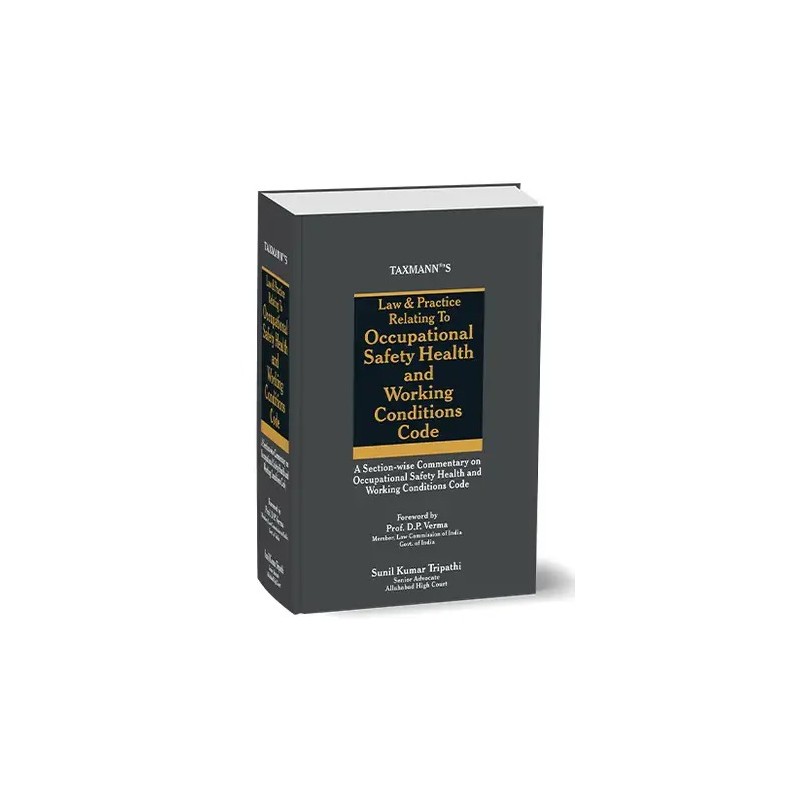
Law & Practice Relating to Occupational Safety Health and Working Conditions Code
Law & Practice Relating to Occupational Safety Health and Working Conditions Code\
Description
Law & Practice Relating to Occupational Safety Health and Working Conditions Code is a section-wise commentary, written by Sunil Kumar Tripathi, Senior Advocate, drawing on nearly five decades of practice in labour and industrial law before Labour Courts, Industrial Tribunals and the Allahabad High Court.
The book is built on a comparative method applied provision by provision. For virtually every section, and for every individual defined expression in the definition clause, the author places the new provision beside the corresponding provisions of the thirteen repealed enactments in parallel columns, so that the reader can see for himself what has been carried over, what has been altered and what has been dropped. That apparatus recurs 211 times. On that foundation, the commentary builds 1,041 numbered analytical paragraphs, each addressing one discrete question raised by the provision, supported by close to 350 judicial decisions and by the text of the Occupational Safety, Health and Working Conditions (Central) Rules 2026, reproduced in the section each rule serves.
The author’s purpose is not to restate the Code but to identify the grey areas that require clarity for those who must take decisions under it. The book accordingly tells the reader where settled authority under the Factories Act, the Mines Act and the Contract Labour Act continues to govern, where the new language has moved far enough to unsettle it, and where the Code has introduced something with no judicial history at all. It is written in deliberately plain language, on the author’s stated premise that HR and IR managers, trade union leaders, employers and employees are frequently not law graduates.
Beyond the commentary, the volume functions as a self-contained working library: it reproduces the Central Rules 2026 in full, the provisions of eighteen other enactments the Code borrows from, and forty-seven notifications and orders issued under the Code, so that a question can normally be closed without reaching for a second book.
The Present Publication is the 1st Edition, updated till 15th August 2026. It is authored by Sunil Kumar Tripathi, with the following noteworthy features:
- [The Comparative Method Approach] The book’s distinguishing feature is that the author does not present the Code in isolation. For each provision he first lists, by section number and Act, every corresponding provision of the repealed statutes, and then sets the two texts in parallel columns. Where a column is empty, the departure is visible on the page without the author having to argue it. This is what makes the volume usable for advising on matters still governed by the old Acts as well as on fresh compliance
- [Numbered Analytical Paragraphs] The commentary is not a paraphrase of the statute. It is organised into 1,041 separately numbered analytical heads, each taking up one discrete question. The author supplies a ‘Prelude’ to 142 of the 143 sections and a clause-by-clause ‘Analysis of section’ to 137 of them, before working through the topical heads
- [The Central Rules, 2026 Reproduced at the Section They Serve] Where a section is worked out through subordinate legislation, the book carries a dedicated ‘Relevant Rule(s)’ block immediately after the statutory text, reproducing the applicable rules verbatim before any analysis begins. Across the commentary, the Rules are cited 165 times, with 270 references to specific numbered rules reaching 143 of the 186 rules, so the obligation and its prescribed mode of discharge are always on the same opening
- [A Working Summary Before Every Analysis] Each section carries a ‘Section Notes’ block that condenses the provision into bulleted working propositions under bold topical sub-headings, often opening with a short ‘Provisions in Brief’ statement. The reader who needs only the operative rule can stop there; the same layer serves as a revision aid on a second reading
- [Written by a Senior Advocate with Fifty Years at the Bar] The treatment reflects sustained trial, appellate and High Court practice in factories, mines, working journalists, medical representatives and contract labour matters. It consistently anticipates the questions that arise in inspection, registration, licensing, prosecution and adjudication rather than only those that arise on a reading of the text
- [Close to 350 Judicial Decisions, with a Fourteen-Page Table] The author builds on decisions of the Supreme Court, High Courts and Tribunals, among them Bangalore Water Supply & Sewerage Board v. A. Rajappa, the Constitution Bench in SAIL v. National Union Waterfront Workers, Balwant Rai Saluja v. Air India Ltd. and the Constitution Bench in Municipal Corporation of Delhi v. Birla Cotton Spinning and Weaving Mills. A consolidated List of Cases keyed to paragraph numbers, not page numbers, precedes the commentary
- [Grey Areas Named Rather Than Smoothed Over] The author states in his Preface that his object is to identify the grey areas requiring clarity, and the book does so candidly. It flags, for example, that Part I of Chapter XI is silent on whether the fifty-worker licensing threshold reaches a contractor awarded a work contract as distinct from a manpower supply contract, and it records that the Industrial Disputes Act and the Standing Orders Act stand un-repealed. Where the Code leaves a question open, the book says so
- [Amended & Updated] The commentary engages with the most recent litigation on the working of the labour codes, including Tech Mahindra Ltd. v. Union of India [2026 LLR 128 (Bom. HC)], United Labour of Federation v. Union of India [2026 LLR 135 (Mad. HC)], N.A. Sebastian v. Union of India [2026 LLR 256 (Del. HC)] and Glastronix LLP v. Glastronix Karmika Sangha [2026 LLR 390 (Karn. HC)]
- [Aligned to the New Criminal Codes] Where the Code operates against the general criminal law, the author states the position under the Bharatiya Nyaya Sanhita 2023, the Bharatiya Nagarik Suraksha Sanhita 2023 and the Bharatiya Sakshya Adhiniyam 2023 rather than leaving the reader with the superseded IPC, CrPC and Evidence Act provisions, so that cognizance, limitation, compounding, procedure and evidence are current
- [Constitutional Doctrine Brought to the Rule-Making Powers] Chapter XIV, which confers unusually wide rule, regulation and bye-law making powers, receives 139 analytical heads across 217 pages, in which the author applies the settled doctrine on excessive delegation, delegatus non potest delegare, sub-delegation, conditional delegation and judicial review of subordinate legislation, and analyses repeal and savings through section 6 of the General Clauses Act 1897
- [Self-Contained Reference Apparatus] Footnotes point to the reproduced text of borrowed provisions in the Appendix rather than sending the reader elsewhere, and the volume closes with a 44-page Subject Index carrying 214 main entries and over 1,140 sub-entries, keyed to paragraph number, with every defined expression listed separately
The book applies a single repeating architecture to every unit, with a unit being either a section or, in Chapter I, an individually defined expression. Each unit opens with the statute, moves through the subordinate legislation, comparison and summary, and closes with analysis and cross-reference, so a reader may enter at any point without having read what precedes it.
- Statutory Text — The unit begins with the bare text of the provision as enacted, reproduced in full with every sub-section, proviso, Explanation and clause marker intact. Running heads carry the section number on the outer edge of every page, with the name of the Code at the centre of left-hand pages and the chapter title at the centre of right-hand pages, so the provision under discussion is identifiable from any page opening. Numbered footnotes record enforcement particulars and notification numbers, while asterisked and daggered footnotes point to the text of borrowed provisions in Appendix 2
- Subordinate Legislation — Where rules have been framed for the provision, a block headed ‘Relevant Rule(s)’ follows immediately, naming the rule numbers and reproducing the text of the Central Rules 2026 verbatim, before any commentary begins
- Comparative Apparatus — Next comes the block headed ‘Comparative Study of Provisions of Occupational Safety, Health and Working Conditions Code 2020 & Old Labour Laws’, in two parts. First, ‘Corresponding provisions’, a bulleted statement identifying by section number and Act every provision of the repealed statutes to which the unit corresponds. Second, a two-column comparative table, with the Code provision on the left and the text of each corresponding old provision on the right, reproduced verbatim and stacked one below the other under its own sub-heading
- Summary Apparatus — The block headed ‘Section Notes’ condenses the provision into working propositions, often opening with ‘Provisions in Brief’ and then proceeding through bold topical sub-headings under each of which the operative obligations are set out as bulleted declarative sentences
- Analytical Apparatus — The substantive commentary follows under the heading ‘Comments’, on a decimal paragraph numbering system in which the first element is the section number and the second the running serial of the head. Within each unit the heads follow a settled progression:
- ‘Prelude to section…‘, giving the constitutional, historical and legislative setting of the provision and its place within its Chapter, frequently opening from the Directive Principles
- ‘Analysis of section‘, a clause-by-clause dissection in which each limb is restated under a bold descriptive label and broken into numbered and lettered components
- Topical heads, each addressing one discrete question of scope, ingredients, exclusions, thresholds, procedure, powers of exemption or consequences of default
- ‘Cases relating to…‘, collecting the decided authorities on the corresponding provision of the repealed Act, with citations and an indication of how far each continues to govern
- Case names are set in italics with superscript reference numbers resolved in footnotes on the same page, and extracts from judgments are set in indented, smaller type so the court’s words are distinguishable from the author’s analysis
- Closing and Cross-reference Apparatus — Every authority is traceable through the List of Cases, keyed to paragraph numbers. The Subject Index reproduces the same numbering, listing each section by its marginal heading with its analytical heads nested alphabetically beneath it, and each defined expression separately with its page reference. A concept can therefore be reached through the index, through the List of Cases, or through the comparative tables that lead from a repealed provision to its present counterpart.
About the Author
Mr Sunil Kumar Tripathi is a Senior Advocate and one of India’s leading authorities on labour and industrial law, with nearly five decades at the Bar. A graduate in Law (LL.B.) of Banaras Hindu University (1976), he enrolled with the Bar Council of Uttar Pradesh in 1977 and practised before Labour Authorities, Labour Courts and Industrial Tribunals across the country. Since 2001 he has appeared before the Allahabad High Court