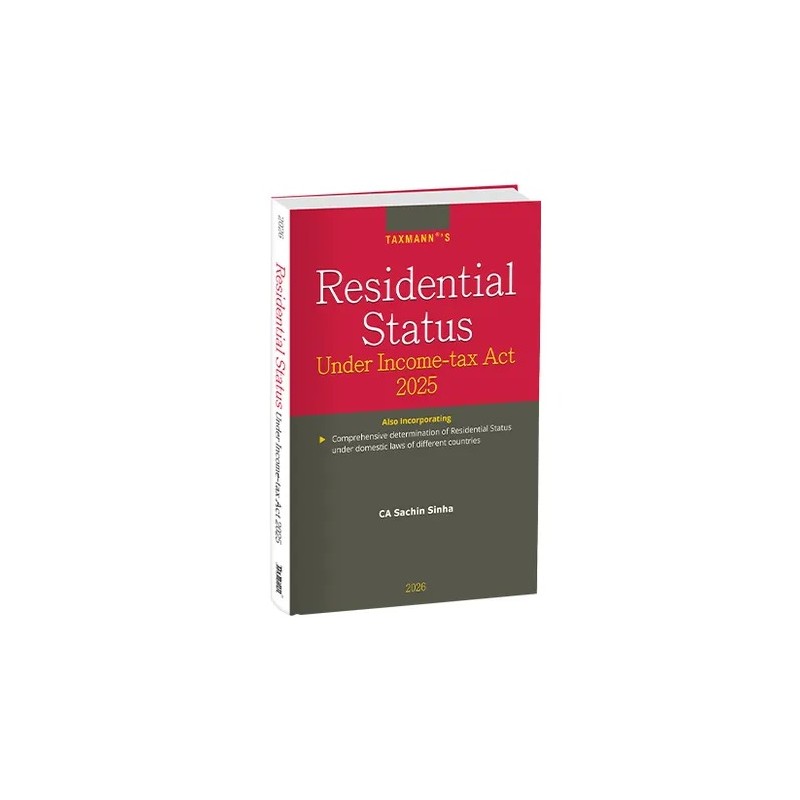
Residential Status under Income-tax Act 2025 by Sachin Sinha Edition 2026
Residential Status under Income-tax Act 2025 by Sachin Sinha Edition 2026
Description
Residential Status under Income-tax Act 2025 is a single-subject treatise. It is written for the practitioner who must reach a defensible conclusion on a residence question and produce the work to support it.
The book is written on the Income-tax Act 2025, and is among the first titles to restate residence law under the new enactment. It is designed to be used while both statutes are still in play: more than fifty bracketed in-line cross-references tie each provision to its counterpart under the Income-tax Act 1961, running in both directions, and a dedicated chapter of nineteen FAQs deals with nothing but the repeal, the savings clause and the questions that arise when a taxpayer’s history straddles the two Acts.
Three things separate it from a conventional commentary. First, it argues rather than merely reports: where the authorities conflict, or the statute is silent, the author sets out the competing readings and reasons for a stated position, and where he cannot settle a point he says so and identifies the difficulty. Second, it does not stop at the Indian border, devoting a full chapter to the domestic residence rules of eleven other jurisdictions so that a dual-residence question can be tested from both ends. Third, it reproduces its primary material rather than summarising it: the OECD Commentary on Article 4 with the member States’ Observations and Reservations, the UN Model Commentary, the CBDT Guiding Principles on POEM in full, and seven circulars and releases in an appendix.
The practical apparatus is substantial. Fifteen worked case studies on dated fact patterns close the book, day-count and income-analysis tables carry the arithmetic in full, roughly two dozen short worked examples are threaded through the commentary, and every decision cited is footnoted at the foot of its own page and indexed by paragraph number in a 63-entry List of Cases.
The Present Publication is the 1st Edition, updated till August 2026. It is authored by CA. Sachin Sinha, with the following noteworthy features:
- [A Whole Book On One Concept] The subject that a general commentary disposes of in a few pages is given 161 pages here, with the analysis pushed down to the level of individual statutory phrases: ‘place’, ‘key management’, ‘in substance made’, ‘affairs’, ‘situated wholly’, ‘set up’, ‘day’, ‘year’, ‘leaves India’
- [Dual-Act Usability] More than fifty bracketed in-line mappings connect the 2025 provisions to their 1961 counterparts, and back again, so a reader carrying forward an old position can follow it across the change without a separate concordance
- [A Transition Chapter, Not A Transition Paragraph] Nineteen FAQs are devoted to the repeal and savings problem, including which Act governs a reassessment initiated after 1st April 2026, how the continuity counts reach back into repealed-Act years, and what happens to positions already taken under the NRI concessional regime
- [The Author Takes Positions] On the foreign LLP, on the availability of the treaty tie-breaker to a deemed resident, on whether a profession once set up can be set up again, and on the treatment of the arrival date in a day-count, the book reasons to a conclusion instead of listing authorities. Where an answer is genuinely unavailable, it leaves the question open rather than papering it over
- [Comparative by Design] A full chapter covers the residence rules of Singapore, Mauritius, the UAE, the UK, the USA, Australia, China, France, Germany, Hong Kong and the Netherlands, each for individuals and for companies, with the divergence from Indian law stated at each point
- [Primary Material Reproduced, Not Paraphrased] The OECD Commentary on Article 4 runs verbatim with its own paragraph numbering, followed by the Observations of three States and the Reservations of nine, then the UN Model Commentary including the Committee of Experts’ recorded minority view. The CBDT Guiding Principles on POEM are reproduced in full with their five illustrations
- [Updated to the Newest Authority] The book is up to date as of August 2026 and aligns with the 2026 rules and forms, including Rule 8, Rule 75, Rule 76, and Forms 41 and 42
- [Built To Be Worked From] Fifteen case studies, dated fact patterns, day-count tables, computation tables with a Remarks column, and roughly two dozen inline worked examples give the reader arithmetic to follow rather than propositions to accept
- [Navigable] Every cross-reference in the book, including the 63-entry List of Cases, points to a paragraph number rather than a page, and the running heads carry that paragraph number on every page
The coverage of the book is as follows:
- Chapter 1 — Introduction
- Chapter 2 — Significance of the Residency Test
- Chapter 3 — Meaning of Resident and Non-resident
- Chapter 4 — Residential Status for Individuals
- Chapter 5 — Residential Status of HUF, Firm and AOP
- Chapter 6 — Deemed Resident or Stateless Person
- Chapter 7 — Ordinary Resident and Not Ordinary Resident in India
- Chapter 8 — Residential Status of a Company
- Chapter 9 — Interplay of GAAR with Residency Test
- Chapter 10 — Residential Status of the Trust
- Chapter 11 — Tax Residency Certificate
- Chapter 12 — Interplay of Domestic Provisions of Residential Status vis-a-vis Treaty Provisions
- Chapter 13 — Residential Status in Different Contracting States
- Chapter 14 — FAQs on Residential Status
- Chapter 15 — Case Studies
- Appendix
Each chapter follows one pattern, so the architecture is learned once and used throughout.
- Opening — A chapter panel, then a ‘Background’ paragraph fixing the provision, naming its 1961 counterpart and framing the question
- Numbering — A decimal paragraph system rather than continuous prose: bold upper case at the first level, bold sentence case at the second. All cross-references are to paragraph numbers, never pages
- Running Heads — Three parts, alternating by side. Verso: paragraph number, chapter title, folio. Recto: folio, subject of the governing paragraph, paragraph number
- Statutory Text — Reproduced in italics with the counterpart section bracketed immediately after, and conditions broken out as lettered and roman clauses that preserve the drafting hierarchy
- Illustration — Short Example: blocks on named taxpayers, plus four recurring table types: day-count, year-wise stay, income analysis with a Remarks column, and country snapshot
- Sources — Reproduced material keeps its own numbering; decisions are footnoted at the foot of their own page, numbered 1 to 83 across the book
- Closing Chapters Switch Format — Bold interrogative headings with self-contained answers in the FAQs, and italic facts followed by a fixed Solution sequence in the case studies.
About the Author
CA. Sachin Sinha is a Fellow member of the Institute of Chartered Accountants of India and the founding partner of Prakash Sachin & Co., Chartered Accountants. He has over two decades of practice in international taxation, transfer pricing, regulatory compliance, litigation and strategic advisory, and advises multinational groups and high-net-worth individuals on cross-border transactions across multiple jurisdictions.