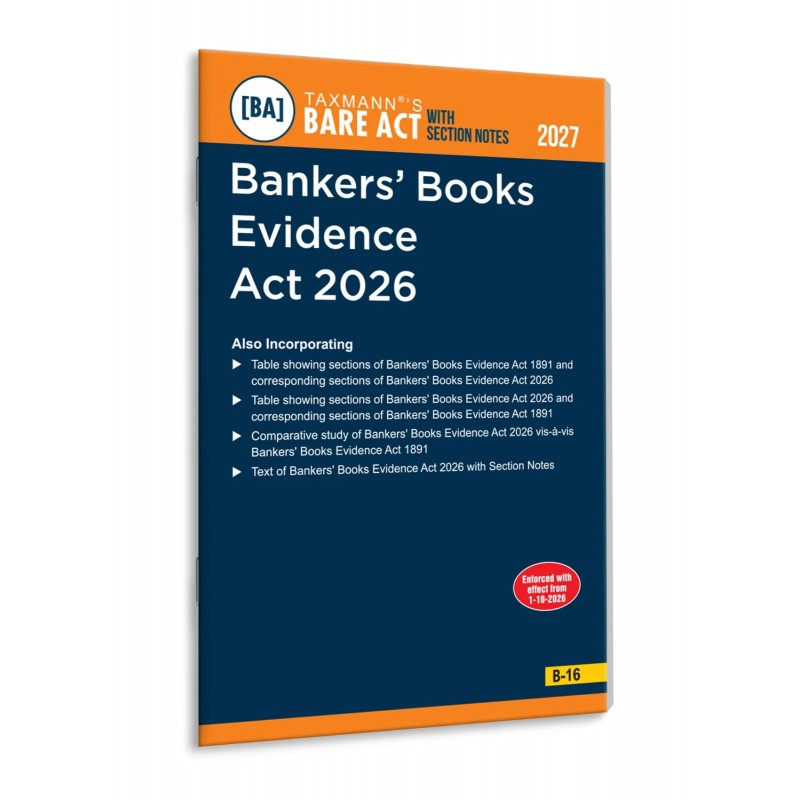
Bankers’ Books Evidence Act 2026 – Bare Act with Section Notes Edition 2026
Bankers’ Books Evidence Act 2026 – Bare Act with Section Notes Edition 2026
Description
Bankers’ Books Evidence Act 2026 [Bare Act with Section Notes] by Taxmann is a single-volume working Edition of the new Act, prepared for its commencement on 1st October 2026 and the move away from the Bankers’ Books Evidence Act 1891. The statutory text is freely available; what this book supplies is the apparatus around it—Section Notes under every section, two cross-reference tables running in both directions between the 2026 Act and the 1891 Act, a Comparative Study placed ahead of the text, the commencement notification in full, both certificate forms, a Subject Index, and an Appendix of outside provisions the Act refers to.
The book solves a practical problem. Anyone working with the new Act has to consult five sources at once:
- The 2026 text
- The 1891 Act it replaces
- The Gazette notification that brings it into force
- The case law that bears on how it is read
- The other Acts it refers to
This volume carries the first in full and maps the second section by section. It reproduces the third, cites the fourth wherever the notes take a position, and prints two of the fifth in an Appendix. Each is tied to the section it concerns.
The Present Publication is the 2027 Edition, covering the text of the Bankers’ Books Evidence Act [Act No. 15 of 2026], with the law stated as updated till 10th September 2026. It has the following noteworthy features:
- [Section Notes – The Core Editorial Feature] Section Notes are printed under all sixteen sections. In fourteen of them, the note states whether the section descends from a numbered section of the 1891 Act or is new. This is the book’s principal editorial labour and its principal utility. The reader can place an old provision against its successor while reading, without turning back to the tables
- [The Correspondence Taken Down to Sub-section Level] Where a section is part old and part new, the note splits it rather than generalising. Section 8 is traced to the 1891 Act for sub-section (1) and marked new for sub-section (2). Section 3 is traced for sub-section (1) and marked new for sub-sections (2) and (3). The reader is told exactly which part of a provision has 1891 history behind it
- [The Definitions Mapped, and the Gaps Marked] The tables map all eight definitions in Section 2(1) one by one. Seven are matched to an 1891 provision, and one (‘notification’) is marked as having none. On the 1891 side, two definitions (‘the Court’ and ‘Judge’) are marked as having no successor. The reader sees at once which defined terms carry forward
- [Borrowed Meanings Traced to Source] The notes to Section 2(2) work through four examples. Each traces a term the Act uses but does not define to the clause of another Act that defines it: ‘evidence’ to the Bharatiya Sakshya Adhiniyam 2023, ‘inquiry’ to the Bharatiya Nagarik Suraksha Sanhita 2023, ‘arbitration’ to the Arbitration and Conciliation Act 1996, and ‘electronic record’ to the Information Technology Act 2000
- [Enforcement Settled on the Opening Page] The date of the Act and the full text of the commencement notification, S.O. 5041(E) dated 10th September 2026, are carried as footnotes on the opening page. The note under Section 1 records the date of assent and the date from which the 1891 Act stands repealed. The reader can check the enforcement position in the book itself rather than take it on trust
- [Two-Way Statutory Cross-Reference Tables] Two tables: one from the 1891 Act to the 2026 Act, with eighteen entries, and a reverse table from the 2026 Act to the 1891 Act, with thirty-one. Each shows section numbers with headings on both sides and goes down to clause level for the definitions. The reverse table also splits Sections 3 and 8 by sub-section. Provisions with no counterpart are marked with a dash, three on the 1891 side and fourteen on the 2026 side. A search that finds nothing is therefore answered rather than left open
- [Front-Placed Comparative Study] Editorial analysis placed before the statutory text, comparing the two Acts under five heads: ‘bankers’ books’, certificates, ‘bank’ and ‘banker’, electronic records, and ‘special cause’. The heads match, one for one, the five objectives in the Statement of Objects and Reasons. Four set the 2026 provision against the 1891 position or record that there was none. All five close with the date from which the change applies. It is the fastest route to the shape of the change before working through the sections
- [The Judicial Anchor for ‘Special Cause’] The Comparative Study and the notes to Section 8 take a stated position: the definition of ‘special cause’ is read as a closed list. The Supreme Court’s 2026 decision in Mumbai Port Authority v. National Commission for Scheduled Castes [2026 INSC 755] and P. Ramanatha Aiyar’s Advanced Law Lexicon support that position. The notes to Section 3 point back to the same reasoning. The reader gets the position and its authority, not only the text
- [Transition Guidance for Applications Already Filed] The notes to Section 8 also say how ‘special cause’ is to be read in applications filed before 1st October 2026, as against those filed on or after it. That guidance rests on the Supreme Court’s 2026 decision in Hemant Kumar v. State of Haryana [2026 INSC 878], the Advanced Law Lexicon (6th Edition) and the Concise Oxford Dictionary
- [The Government’s Clarification, Reproduced] Para 8.2 reproduces the PIB Fact Check clarification of 6th August 2026 on police access to bank records. The notes to Sections 9 and 11 point the reader to it
- [Certificate Requirements Broken into Checklists] The notes to Section 3 turn each certificate requirement into a labelled list. Para 3.1 labels five matters, such as ‘True and correct copy’ and ‘Custody of books’. Four of them line up one for one with the four statements in the First Schedule form. Para 3.2 labels two more, and para 3.3 sets out the dating and signing rules as four points
- [Research Tools] A Subject Index of twenty-three entries maps fifteen section headings and all eight defined terms to their section numbers. Both Schedule certificates are reproduced as forms—the First with four statements, the Second with ten—with blanks for the officer’s particulars and, in the Second, the particulars of the computer system. The Statement of Objects and Reasons is included. An Appendix prints Section 2(20) of the Companies Act 2013 and Section 6 of the General Clauses Act 1897, and footnotes under Sections 2(1)(d) and 16(3) point to it
- [Authoritative Bare Act Presentation] Taxmann’s Bare Act editorial standard is maintained throughout: the statutory text as enacted, supported by Section Notes and corresponding-provision references. A boxed COMMENTS device closes the statutory text and opens the editorial matter, at the head of the Act and under each of the sixteen sections. The words of Parliament are never confused with the publisher’s explanation
The structure of the book is as follows:
- Contents—with page references for every section, both Schedules and the back matter
- Two-Way Sectional Tables
- Sections of the Bankers’ Books Evidence Act 1891 and the corresponding sections of the Bankers’ Books Evidence Act 2026
- Sections of the Bankers’ Books Evidence Act 2026 and the corresponding sections of the Bankers’ Books Evidence Act 1891
- Comparative Study of the Bankers’ Books Evidence Act 2026 vis-à-vis the Bankers’ Books Evidence Act 1891
- Text of the Bankers’ Books Evidence Act 2026, with Section Notes—Sections 1 to 16
- First Schedule—Certificate [See Section 3(1)]
- Second Schedule—Certificate [See Section 3(2)]
- Statement of Objects and Reasons
- Subject Index
- Appendix—Provisions of other Acts referred to in the Bankers’ Books Evidence Act
Taxmann’s Editorial Board
Taxmann’s Research & Editorial Board includes Chartered Accountants, Company Secretaries, and Lawyers working under the editorial direction of Editor-In-Chief Mr Rakesh Bhargava. The team operates at the junction of legal expertise and editorial rigour, producing content that meets the high standards of India’s professional knowledge community.
All content is sourced solely from authorised statutory repositories and is continuously updated to reflect the latest judicial pronouncements and legislative changes. Analysis is based on primary references—sections, rules, circulars, notifications, and rulings—ensuring that every insight is traceable, defensible, and practice-ready.