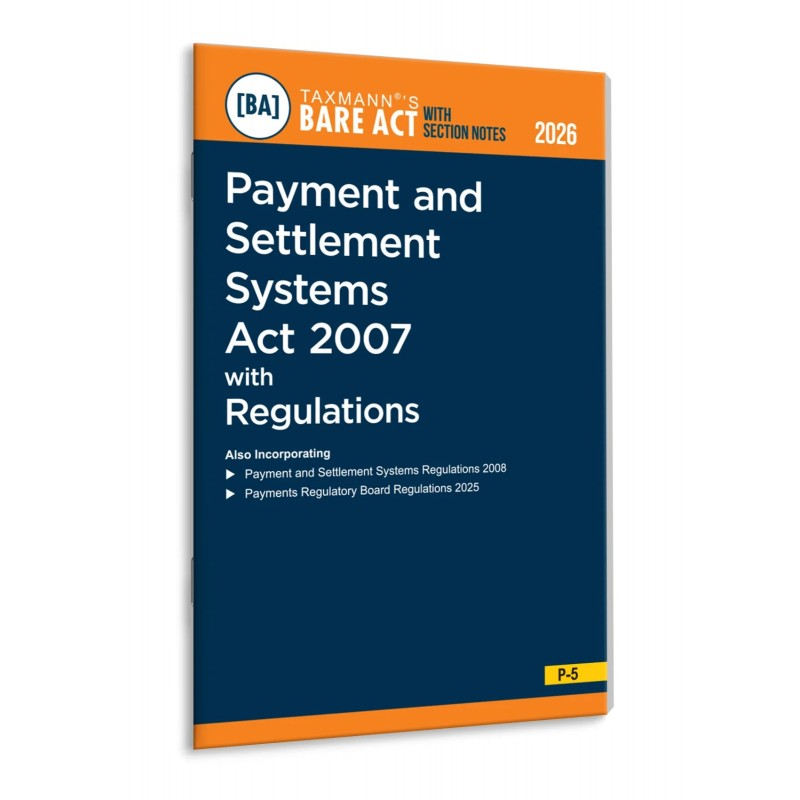
Payment and Settlement Systems Act 2007 Edition 2026
Payment and Settlement Systems Act 2007 Edition 2026
Description
Payment and Settlement Systems Act 2007 [Bare Act with Section Notes] by Taxmann is an authoritative statutory and compliance reference that comprehensively explains the legal, regulatory, and enforcement framework governing payment and settlement systems in India. This publication consolidates the fully updated text of the Act with structured section-wise notes, explanatory commentary, and relevant judicial interpretations, making it a reliable reference for understanding how payment systems are authorised, regulated, supervised, and enforced under Indian law. As India’s digital, electronic, and cashless payment ecosystem continues to expand—covering electronic funds transfers, clearing and settlement systems, card-based payments, fintech platforms, and allied payment mechanisms—the Payment and Settlement Systems Act 2007 remains the foundational statute anchoring regulatory certainty and systemic stability. This volume is designed not merely as a bare reproduction of legislative text, but as a working legal and compliance manual that assists readers in navigating both the statutory provisions and their practical application under the supervision of the Reserve Bank of India.
This book is intended for the following audience:
- Legal Practitioners, Judges, and Law Firms – For statutory interpretation, litigation, compliance advisory, and dispute resolution relating to electronic funds transfer, settlement finality, authorisation of payment systems, and offences under the Act
- Banking & Financial Sector Professionals – For operational heads, compliance officers, risk managers, and internal audit teams in banks, NBFCs, fintech firms, payment aggregators, and authorised payment system providers
- Regulatory and Enforcement Authorities – For officers of the Reserve Bank of India, regulatory bodies, and government departments involved in supervision, inspection, adjudication, and enforcement of payment system laws
- Corporate Legal Departments & Fintech Startups – For in-house counsel, legal teams, and startups engaged in designing, operating, or participating in regulated payment systems and digital payment infrastructure
- Academics, Researchers & Students – For scholars and students of banking law, financial regulation, fintech law, and digital payments jurisprudence
The Present Publication is the 2026 Edition, covering the amended and updated text of the Payment and Settlement Systems Act [Act No. 51 of 2007], with the following noteworthy features:
- [Complete Statutory Text] The full and updated text of the Payment and Settlement Systems Act 2007, incorporating all amendments, insertions, and substitutions operative as of the 2026 Edition
- [Pre-amendment Provisions] Reproduces earlier versions of amended provisions in the relevant footnotes, enabling readers to clearly understand the pre-amendment legal position, transitional application, and historical interpretation of the law
- [Section-wise Notes & Commentary] Detailed explanatory notes under each section, clarifying statutory intent, scope, definitions, compliance obligations, and operational consequences, with particular focus on concepts such as payment systems, netting, settlement, systemic risk, authorisation, and RBI supervisory powers
- [Latest Case Law] Select and relevant judicial decisions interpreting the Act are summarised and referenced under appropriate provisions, highlighting how courts have addressed issues such as authorisation validity, settlement finality, dishonour of electronic funds transfer, vicarious liability, and RBI’s regulatory discretion
- [Updated Regulatory Content] Incorporates the complete and updated text of:
-
- Payment and Settlement Systems Regulations 2008 (including prescribed forms and procedural requirements), and
- Payments Regulatory Board Regulations 2025, reflecting the current governance and regulatory structure through which the Reserve Bank of India exercises its statutory powers
- [Procedural & Compliance Guidance] Section notes provide structured guidance on authorisation applications, conditions of operation, inspection and audit, dispute resolution mechanisms, penalties, compounding of offences, and recovery of penalties
- [Practical Utility] Serves as a ready reckoner for compliance audits, regulatory filings, drafting agreements, responding to inspections, managing disputes, and advising on regulatory exposure for payment system operators and participants
- [Relevance to the Digital Payments Ecosystem] Particularly valuable in the context of India’s evolving digital payments landscape, addressing regulatory concerns surrounding electronic payments, fintech operations, consumer protection, settlement certainty, and systemic risk management
The structure of the book is as follows:
- Chapter-wise Statutory Presentation – The Act is presented in the same sequence as the official gazette, with each chapter prefaced by an overview and followed by detailed section notes
- Section Notes & Comments – Each section is supplemented with concise notes, legislative intent, real-world implications, and practical commentary
- Case Law Digests – Select judicial decisions are summarised under relevant sections for easy cross-reference
- Allied Regulations & Forms – Texts of key regulations and prescribed forms are included for operational clarity and regulatory compliance
- Subject Index – Quick-reference tool to navigate the Act, and helps readers quickly locate specific topics by listing keywords along with section numbers
Taxmann’s Editorial Board
Taxmann’s Research & Editorial Board includes Chartered Accountants, Company Secretaries, and Lawyers working under the editorial direction of Editor-In-Chief Mr Rakesh Bhargava. The team operates at the junction of legal expertise and editorial rigour, producing content that meets the high standards of India’s professional knowledge community. All content is sourced solely from authorised statutory repositories and is continuously updated to reflect the latest judicial pronouncements and legislative changes. Analysis is based on primary references—sections, rules, circulars, notifications, and rulings—ensuring that every insight is traceable, defensible, and practice-ready.