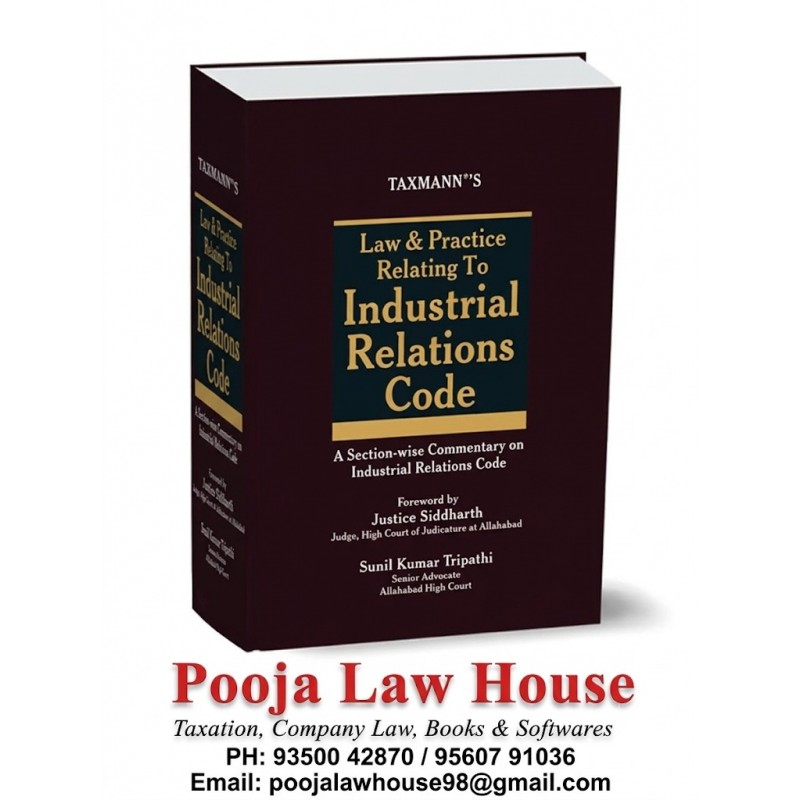
Law & Practice Relating to Industrial Relations Code
Law & Practice Relating to Industrial Relations Code is a one-volume, section-wise commentary on the Industrial Relations Code 2020. It covers every section of the Code in order, from Section 1 to Section 104, and is designed to support the transition from the old labour laws to the Code.
The book is organised around two questions: how does a provision compare with what came before, and what have the courts said about it? It answers the first by reading each provision against the three Acts the Code replaced. It answers the second through case law, from long-settled rulings under the old Acts to recent decisions.
The same volume also carries the rules, forms and notifications a reader needs alongside the commentary. It is a practical reference, meant to be consulted when a question comes up in advice, compliance or litigation.
This book is intended for the following audience:
- Advocates and Legal Practitioners in industrial and labour law, for advice, drafting and arguments
- Members of the Bench and Judicial Officers, as a section-wise reference on the Code
- HR and IR Managers who take decisions on compliance
- Employers, Including Industries and Commercial Establishments, working to implement the Code
- Employees and Trade Union Leaders who want to understand the Code
- Corporate Professionals and Consultants who advise on labour law
- Academicians and Students of Law
The Present Publication is the 2026 Edition. The law stated in it is updated till 30th September 2026. It is authored by Sunil Kumar Tripathi, Senior Advocate, Allahabad High Court, with the following noteworthy features:
- [Old and New, Linked Both Ways] Four tables at the front of the book, running to more than 20 pages, link the old Acts and the Code in both directions. The first lists every section of the Code against the corresponding sections of the old Acts, where there are any. The other three list the sections of the Industrial Disputes Act 1947, the Industrial Employment (Standing Orders) Act 1946 and the Trade Unions Act 1926 against the Code. All four go down to individual definition clauses
- [Every Definition on Its Own] Each of the 44 defined terms is treated as a separate unit, so one term can be looked up and read by itself. Together, the definitions take up nearly 250 pages, with longer topics broken into numbered sub-paragraphs. Before the term-by-term commentary, a short note explains how definitions, provisos, explanations and schedules are read. Some shorter definitions point the reader to the section where the subject is discussed in full.
- [Nearly 1,500 Cases, Updated to 2026] The List of Cases runs to 55 pages and nearly 1,500 entries, arranged alphabetically. The rulings come mainly from the Supreme Court and the High Courts, with a few English decisions. The list includes rulings reported in 2025 and 2026. The commentary covers decisions as recent as the nine-judge Constitution Bench ruling of 20th August 2026
- [Key Passages Quoted] Where a point turns on a judgment, the commentary often sets out the key passage as an indented extract. Where it turns on another statute, such as the Code of Civil Procedure, the Indian Penal Code or the General Clauses Act, the relevant text is often reproduced in place. At those points, the reader need not reach for another book
- [Rules Where They Apply] The commentary refers to the Industrial Relations (Central) Rules 2026, notified on 8th May 2026, in its discussion of more than 20 sections. The rules on recovery of dues, and on notices of strike and lock-out, are printed directly below their sections. The rules on retrenchment and closure are printed at the start of Chapter IX
- [Procedures and Distinctions Signposted] Nearly 30 paragraphs are headed as procedures, so the reader can go straight to how a thing is done. A few paragraphs are given over entirely to how two related terms differ
- [A Handbook on Disciplinary Proceedings] At about 90 pages, the commentary on Section 50 is the longest after the definitions. Across 39 numbered paragraphs, it works as a handbook on disciplinary proceedings. It follows the stages in order, from the preliminary enquiry to the relief the Tribunal can grant
- [Background Where It Helps] Where history explains the present text, the commentary traces it. It sets out how each of the three repealed Acts came about, and how works committees, trade unionism and standing orders developed
- [Plain Language] As the Preface explains, many readers, such as HR and IR managers, trade union leaders, employers and employees, are not law graduates. The author therefore uses simple language and avoids needless jargon
Each section of the Code is presented in the same way:
- Statutory Text — The section is set out in full under its marginal heading
- Overview Box — An opening box maps the commentary that follows. It names the parts of the commentary and lists the topics discussed, with their paragraph numbers
- Comparative Study — A note names the corresponding provisions of the repealed Acts, and the section is then printed side by side with their text. Where a section draws on more than one old Act, each one is printed. Where the provision is new, the note says there is no corresponding section
- Section Notes — In most sections, a point-wise summary of what the section provides, under side-heads, for a quick reading before the detailed commentary.
- Comments — Numbered paragraphs, usually opening with a prelude that introduces the section. In most sections, an analysis then breaks the section into its parts. Each issue is then taken up under its own heading
- Footnotes — A footnote gives each section’s date of enforcement. Footnotes also carry the case citations and point to the text of other Acts in Appendix 2