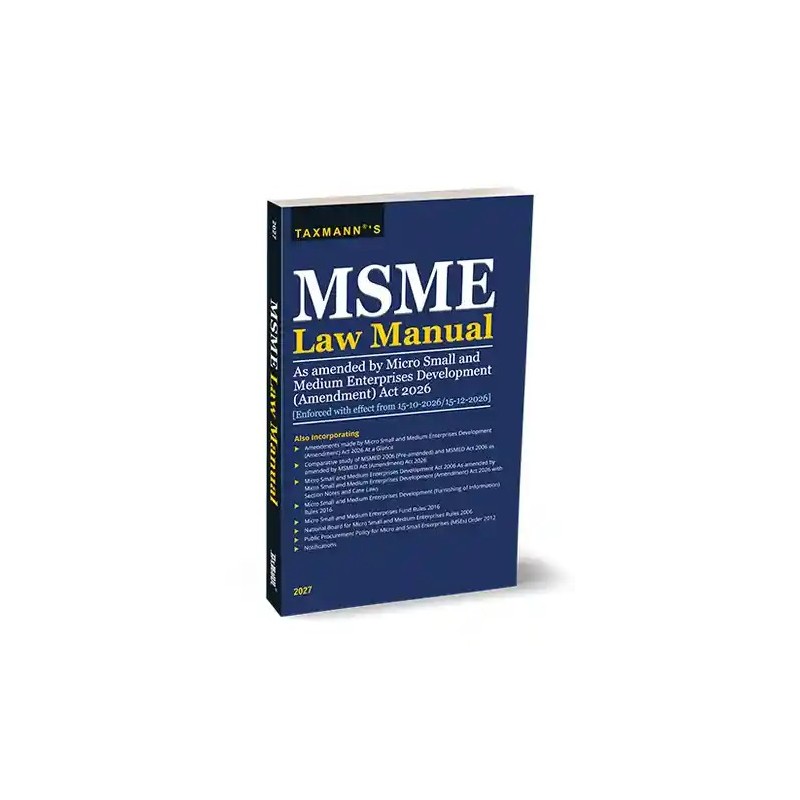
Taxmann MSME Law Manual
MSME Law Manual is a one-volume reference on the Micro, Small and Medium Enterprises Development Act 2006 (MSMED Act), updated for the Micro, Small and Medium Enterprises Development (Amendment) Act 2026. It brings together the Act with Section Notes and Case Laws, three sets of rules made under it, the Public Procurement Policy for Micro and Small Enterprises (MSEs) Order 2012 and five key notifications.
The book is built around three questions that come up with the amended Act: what changed, from when, and how the courts have read the provisions. The amendment table and the Comparative Study at the front answer the first two. The notes and rulings placed under the sections they explain answer the third.
This book is intended for the following audience:
- MSME Owners and Entrepreneurs, for Udyam Registration, classification, payment rights and procurement benefits
- Chartered Accountants and Tax Auditors, for MSME dues in annual accounts and tax audit reports
- Company Secretaries and Compliance Professionals, for registration, compliance and the new penalty and adjudication process
- Advocates and Arbitration Practitioners, for references to Facilitation Councils, mediation, arbitration and challenges to awards
- Members and Officers of Micro and Small Enterprises Facilitation Councils, for jurisdiction, procedure and timelines
- CFOs and Finance Teams of buyers, for payment deadlines, interest on late payment and its tax treatment
- Central and State Public Sector Enterprises and Government Buyers, for the TReDS mandate, compliance reporting and public procurement
- Banks and Lenders, for MSME status in recovery cases, the revival and rehabilitation framework and Udyam Assist certificates
- Students, Academics and Researchers of business and commercial law
The Present Publication is the 2027 Edition, edited by Taxmann’s Editorial Board. It covers the MSMED Act as amended by the Micro, Small and Medium Enterprises Development (Amendment) Act 2026 [16 of 2026], enforced with effect from 15th October 2026 and 15th December 2026. The changes to sections 18, 18A and 19, whose date is yet to be notified, are also included and marked as such. The law stated in the book is updated till 1st September 2026. It also carries Notification S.O. 5575(E), dated 12th October 2026, which appointed the dates of enforcement. The noteworthy features of the book are as follows:
- [Every Amendment at a Glance] A two-page table at the front lists all 20 provisions changed by the 2026 Amendment Act. For each, it gives the nature of the change (inserted, substituted or omitted) and, where notified, its date of effect
- [Before and After, Change by Change] A 13-page Comparative Study takes the main amendments in 14 heads. Each head states when the change takes effect. Most explain what changed and set the new provision against the old one. The study opens by matching each stated aim of the Amendment Act to the section that carries it out
- [Classification Limits Traced] A table in the study tracks the limits for micro, small and medium enterprises, in manufacturing and in services. It runs from the original investment limits under section 7(1) to the investment and turnover limits set by Notification S.O. 2119(E) from 1st July 2020 and revised by Notification S.O. 1364(E) from 1st April 2025
- [Section Notes on 25 Sections] Section Notes accompany 25 of the Act’s 36 sections. Most explain the provision point by point, and the notes on amended sections show how the change alters the earlier position. Chapter V, on delayed payments, also opens with its own Chapter Notes. Four 2026 Supreme Court rulings help read the new wording: on the word ‘substitute’, the word ‘namely’, the weight of a marginal heading and the line between a false and a wrong statement
- [Case Laws Where They Apply] Nearly 70 rulings are placed with the sections they concern. They include 20 rulings of the Supreme Court and more than 30 reported in 2025 and 2026, along with decisions of High Courts across the country, the NCLT and the Income-tax Appellate Tribunal
- [Facilitation Council Disputes in Depth] Section 18, on references to the Facilitation Council, carries the largest body of case law in the book: 34 rulings over 12 pages. They deal with who can make a reference, registration, limitation, arbitration clauses, the conduct of conciliation and arbitration, and the setting aside of awards
- [Old Text Kept on the Page] Where a section or sub-section has been substituted, a footnote reproduces its earlier text in full, as for sections 7(1), 8, 19, 20, 21 and 27. Anyone dealing with a transaction or dispute from before the change has both versions in front of them
- [Official Guidance in the Notes] The notes draw on the Government’s own material, including a 2007 circular, MSME Samadhaan FAQs, a 2020 Office Memorandum and Press Information Bureau releases of July and August 2026. The notes on section 7 summarise the main paras of Notification S.O. 2119(E), which governs classification and Udyam Registration. The TReDS mandate is explained with the July 2026 release and a timeline chart of the TReDS reform from 2017 to June 2026
- [Linked to the New Income-tax Act] The notes link MSME payment rules with tax. They point to the disallowance of late payments under section 43B(h) of the Income-tax Act 1961 and section 37(2)(g) of the Income-tax Act 2025. They also point to tax audit reporting in Form No. 3CD under the Income-tax Rules 1962 and Form No. 26 under the Income-tax Rules 2026. In places, the new section number under the 2025 Act is given next to the old one
The coverage of the book is as follows:
- Amendments made by the MSMED (Amendment) Act 2026 at a Glance
- Comparative Study of the MSMED Act 2006 (pre-amended) and the MSMED Act 2006 as amended by the MSMED (Amendment) Act 2026
- Division One | Micro, Small and Medium Enterprises Development Act 2006
- Arrangement of Sections
- The Act as amended, with Section Notes and Case Laws, in six chapters:
- Chapter I: Preliminary (Sections 1 and 2)
- Chapter II: National Board for Micro, Small and Medium Enterprises (Sections 3 to 6)
- Chapter III: Classification of Enterprises, Advisory Committee and Memorandum of Micro, Small and Medium Enterprises (Sections 7 and 8)
- Chapter IV: Measures for Promotion, Development and Enhancement of Competitiveness of Micro, Small and Medium Enterprises (Sections 9 to 14)
- Chapter V: Delayed Payments to Micro and Small Enterprises (Sections 15 to 25, including new Sections 15A, 18A and 22A)
- Chapter VI: Miscellaneous (Sections 26 to 32, including new Section 27A)
- Subject Index
- Appendix: Text of the provisions of allied Acts referred to in the MSMED Act, from the Constitution of India, the Industries (Development and Regulation) Act 1951, the Khadi and Village Industries Commission Act 1956, the National Bank for Agriculture and Rural Development Act 1981, the Reserve Bank of India Act 1934 and the Small Industries Development Bank of India Act 1989
- The MSMED (Amendment) Act 2026, in full
- Statement of Objects and Reasons of the amending Bill
- Division Two | Rules and Regulations
- MSMED (Furnishing of Information) Rules 2016, with the Data Bank form
- Micro, Small and Medium Enterprises Fund Rules 2016
- National Board for Micro, Small and Medium Enterprises Rules 2006
- Public Procurement Policy for MSEs Order 2012, with the Order constituting its Review Committee and the list of 358 items reserved for purchase from MSEs
- Division Three | Notifications
- Five notifications, on:
- The authorities for filing the memorandum of a medium enterprise (2006)
- Udyam Assist certificates for priority sector lending (2023)
- Classification of enterprises and Udyam Registration (S.O. 2119(E) of 2020, as amended)
- The TReDS mandate for Central Public Sector Enterprises (June 2026)
- The enforcement dates of the 2026 Amendment Act (October 2026)
Each section of the Act is laid out in this order, where the parts apply:
- Statutory Text — The section is set out under its marginal heading. Text inserted or substituted in 2026 is printed in italics within square brackets, and omitted words appear as [***]. Each change is keyed to a footnote that records the amending law and when the change takes effect
- Pointers to the Appendix — An asterisk against a provision of another law sends the reader to its text in the Appendix
- COMMENTS — A boxed COMMENTS heading marks where the statute ends and the editorial matter begins
- Section Notes — Point-wise notes follow. On the longer sections, they run under numbered side-heads
- Case Laws — Rulings follow under their own heading. Most open with a bold headnote that states the point decided, then give the facts and the holding, and close with the citation. In section 2, rulings sit under the definition they concern
- The rules, the Order and the notifications follow a common pattern:
- Rules, Order and Notifications — Each set of rules and the Order opens with its own Arrangement of Rules or Paras and gives its notification number and date under the title. Footnotes record later amendments, where there are any. Each notification is numbered and headed with the provision it is issued under and its subject