
• -20%

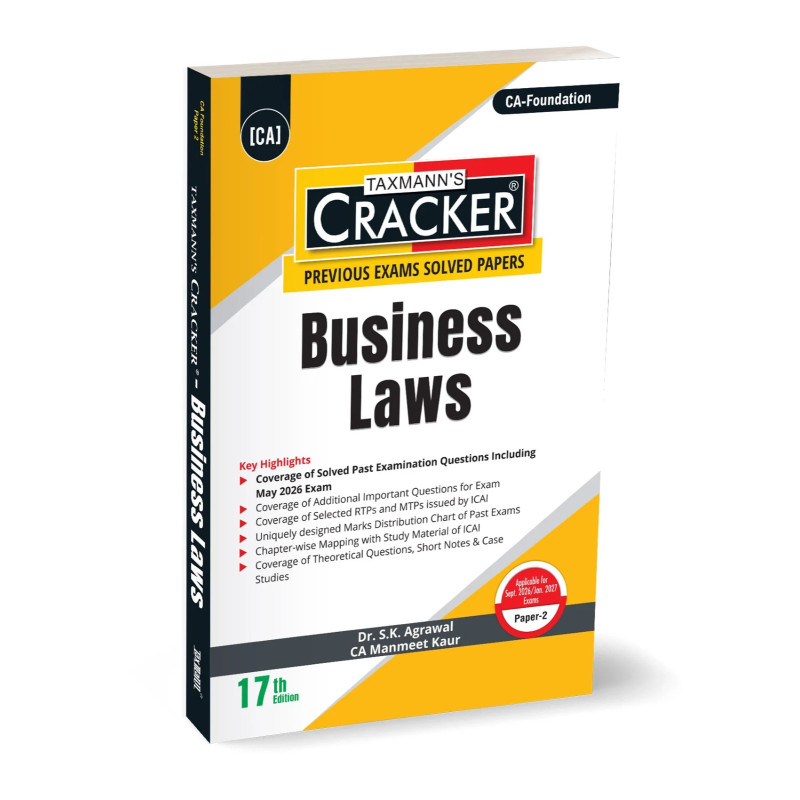
Taxmann CA Foundation Business Laws Cracker By Manmeet Kaur S.K. Agrawal Sept 26 & Jan 27

₹475.00
₹380.00 Save 20%
Tax excluded
Quantity

CA Foundation Business Laws Manmeet Kaur S.K. Agrawal Sept 26 & Jan 27

CA Foundation Business Laws Manmeet Kaur S.K. Agrawal Sept 26 & Jan 27

Descriptions –

Business Laws – CRACKER (Previous Exams Solved Papers) is Taxmann’s chapter-wise compilation of solved questions from past CA Foundation examinations for Paper 2 – Business Laws, prepared in accordance with the syllabus under the New Scheme of Education & Training of ICAI. The book distils eight years of examination history, covering every attempt from May 2018 to May 2026, into a single, classified practice resource. Each question is source-tagged, answered in examination style, and supplemented with additional important questions, selected RTPs/MTPs, and attempt-wise trend analysis that shows students exactly where ICAI allocates marks.

The Present Publication is the 17th Edition, authored by Dr S.K. Agrawal & CA. Manmeet Kaur, with the following noteworthy features:

  • [650+ Solved Questions, Including the May 2026 Exam] A comprehensive bank of past examination questions drawn from every attempt between May 2018 and May 2026—covering the earlier and current scheme wherever relevant to the present syllabus—each solved with a suggested answer in examination style
  • [Complete Examination Footprint on Every Question] Each question carries its full source trail—attempt(s), marks and RTP/MTP appearances (e.g., [June 2022, 4 Marks; RTP Jan. 2025; RTP Sept. 2025; MTP Jan. 2026])—so students can instantly see which questions ICAI repeats, and how often
  • [‘OR’-Grouped Question Variants] 90+ alternatively worded versions of the same question from different attempts are clubbed under a single answer, training students to recognise one concept behind many phrasings
  • [Additional Important Questions] Fresh practice questions are interspersed throughout every chapter to cover examinable areas beyond what has already been asked
  • [Selected RTPs & MTPs of ICAI] Extensive coverage of questions from ICAI’s Revision Test Papers (up to the May 2026 RTP) and Mock Test Papers (up to the Jan. 2026 series)
  • [Uniquely Designed Marks Distribution Charts] Chapter-wise, attempt-wise marks analysis of the last nine examinations (June 2023 – May 2026), segregated into Short Answer Type (2/3/4 marks), Long Answer Type (5/6/7 marks) and Case Studies, with compulsory questions flagged—making patterns visible at a glance, such as a compulsory question drawn from the Companies Act 2013 in all nine attempts (a case study in eight of them), and the two new-scheme additions (Indian Regulatory Framework and the Negotiable Instruments Act) examined in every attempt since June 2024
  • [Chapter-wise Mapping with ICAI Study Material] A comparison table linking every chapter of the book to the corresponding chapter and unit of the ICAI Study Material for seamless cross-referencing
  • [All Major Question Formats] Long-answer/descriptive questions, short-answer questions, case studies, ‘distinguish between’ questions and short notes—mirroring how the paper is actually framed
  • [Answer-Writing Guidance] A dedicated ‘Note to Students’ explains the three-part Provision–Connection–Conclusion technique for case studies—state the legal provision, connect it to the facts, and conclude with the remedy—the same method followed in answers across the book
  • [Landmark Case Laws Integrated] Answers are anchored in statutory provisions and reinforced with leading judicial precedents—Carlill v. Carbolic Smoke Ball Co., Hadley v. Baxendale, Daimler Co. v. Continental Tyre, Gilford Motor Co. v. Horne, and others—building the legal-language answering style examiners reward

The book covers the entire syllabus of CA Foundation Paper 2 across seven units:

  • Unit I | Indian Regulatory Framework
    • India’s legal architecture, sources of law, the law-enforcing framework, hierarchy of the judiciary, and the roles of key ministries and regulatory bodies
  • Unit II | Indian Contract Act 1872
    • The largest unit, spread over thirteen chapters—Nature of Contract, Offer & Acceptance, Capacity to Contract, Consideration, Free Consent, Legality of Object & Consideration, Void Agreements, Contingent & Quasi-Contracts, Performance of a Contract, Discharge of a Contract, Indemnity and Guarantee, Bailment and Pledge, and Agency
  • Unit III | Sale of Goods Act 1930
    • Formation of the Contract of Sale, Conditions & Warranties, Transfer of Ownership, and Unpaid Seller
  • Unit IV | Indian Partnership Act 1932
    • General Nature of a Partnership, Relations of Partners, and Registration of a Firm & Dissolution of a Firm
  • Unit V | Limited Liability Partnership Act 2008
    • Nature, incorporation and operation of LLPs
  • Unit VI | The Companies Act 2013
    • The single largest chapter of the book (90+ questions), covering corporate personality and lifting of the corporate veil, classes of companies (including OPCs, guarantee and Section 8 companies), memorandum and articles, share capital and its kinds, and the doctrines of ultra vires, constructive notice and indoor management
  • Unit VII | The Negotiable Instruments Act 1881
    • Promissory notes, bills of exchange, cheques, dishonour and Section 138 prosecution, with answers applying the provisions to practical scenarios

The structure of the book is as follows:

  • Unit & Chapter Architecture — The book is organised into 7 units—mirroring the seven chapters of the ICAI Study Material—which are further split into 24 exam-oriented chapters, with the Indian Contract Act alone spanning thirteen
  • Opening Sections — The preliminary pages comprise the Note to Students, the Chapter-wise Marks Distribution of Previous Examinations, and the Chapter-wise Comparison with Study Material
  • Format-wise Question Grouping — Within the chapters, questions are grouped into Long Answer Questions, Short Answer Questions and Case Studies (as applicable), supplemented at select places by dedicated ‘Differences’ sections
  • Provision-first Answer Framework — Answers reproduce the statutory provision first and close with an applied conclusion—over 175 answers culminate in the signature ‘Thus, applying the above-stated provisions…’ reasoning
  • Hint-based Answers — At select places, concise hint-based answers (140+ across the book) provide a short reference to the applicable provision and conclusion—a deliberate design choice, explained by the authors, to balance brevity with wider question coverage
  • Guidance on the Evolving Paper Pattern — A note accompanying the marks charts cautions that ICAI has begun integrating concepts from multiple chapters into single questions, so the chapter-wise tally is indicative—itself a useful steer on how the paper is evolving

About the authors

Dr S.K. Agrawal holds a doctorate from Kanpur University and boasts over 23 years of teaching experience. He has been dedicated to imparting knowledge and values at Sky Academy (Kanpur). With a postgraduate degree in Commerce and a B.Ed., Dr Agrawal teaches accountancy to students in classes XI and XII, as well as CA-Foundation/CPT and CA-Intermediate/IPC levels.

CA Manmeet Kaur, an FCA, B.Com, and M.A. (Economics) from Kanpur University, specialises in teaching several key papers:

  • Paper 2 – Business Laws & Business Correspondence & Reporting at the CA Foundation Level (formerly Mercantile Law at CPT level)
  • Corporate & Other Laws (formerly Law, Ethics & Communication at IPC level) in Group I at the Intermediate level
  • Paper 7 – Enterprise Information Systems & Strategic Management (formerly IT/SM at IPC level) in Group II at the Intermediate level
Taxmann
49 Items

Specific References