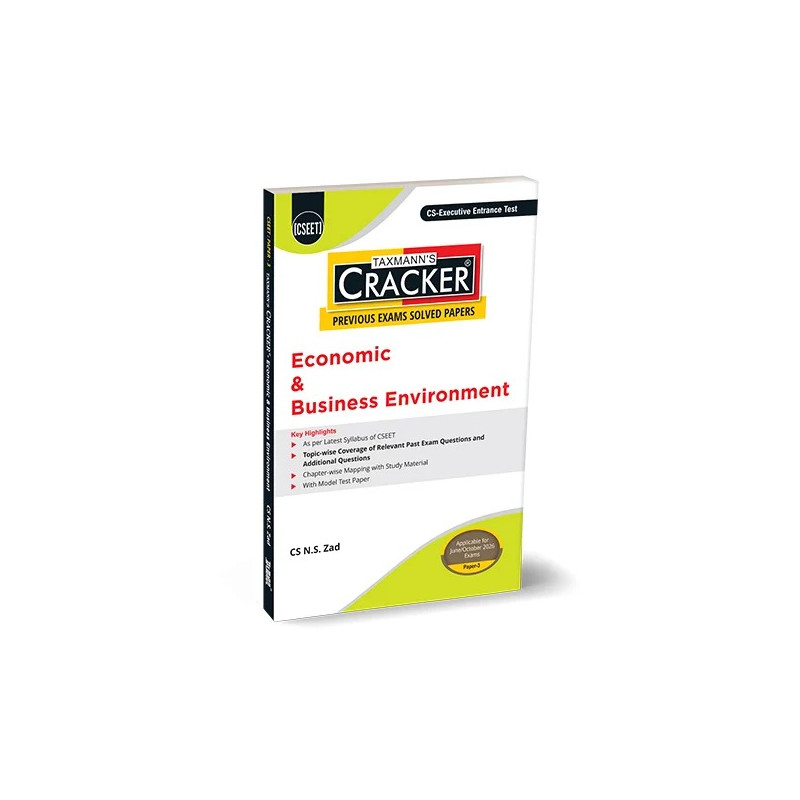
CSEET Economic & Business Environment Cracker N.S. Zad June 26
The Present Publication is the March 2026 Edition, authored by CS N.S. Zad, with the following noteworthy features:
- [Latest Syllabus Alignment] The content is carefully structured to align with the current CSEET syllabus notified by the ICSI, ensuring no gaps in coverage or outdated material
- [Topic-wise Past Exam Question Coverage] Each chapter incorporates relevant past examination questions, tagged with the examination session and marks (e.g., [June 2021 (3 Marks)]), giving candidates clear insights into examiner preferences, question patterns, and marking trends
- [Additional Questions Beyond Past Papers] Alongside past exam questions, each chapter includes extra questions to address conceptual gaps and broaden coverage to areas with high examination likelihood that may not have appeared in past papers
- [Chapter-wise Mapping with Study Material] A dedicated Chapter-wise Comparison Table aligns each chapter of this CRACKER with the corresponding chapter in the official Study Material. This allows candidates to switch smoothly between reading concepts and practising questions, without losing their sense of structure
- [Model Test Paper with Suggested Answers] The book ends with a full-length Model Test Paper accompanied by suggested answers—offering a simulated exam experience and a final benchmark before the real test
- [Three-Layer Question Architecture] Within each chapter, questions are categorised into:
- Theoretical Questions—definitional, conceptual, and analytical
- Practical Problems—numerical and calculation-based (especially in Economic Environment chapters)
- Distinction Questions—compare-and-contrast format common in professional examinations
The book is divided into two parts, covering a total of 12 chapters.
- Part A — Economic Environment (Chapters 1–5)
- Chapter 1 on the Basics of Demand & Supply and Forms of Market Competition covers demand-supply mechanisms, elasticity, price discrimination, and market structures from perfect competition to monopoly. It features both conceptual questions and numerical exercises, with past exam questions included throughout
- Chapter 2 on National Income Accounting & Related Concepts covers GDP, GNP, and related aggregates, along with methods of national income estimation and worked numerical problems, including GDP deflator calculations
- Chapter 3 on the Indian Union Budget examines the structure of the Union Budget, revenue versus capital receipts and expenditure, fiscal deficit, taxation policy, and the budget’s role in macroeconomic management, with practical problems based on hypothetical budgetary data
- Chapter 4 on Indian Financial Markets discusses the role and functions of financial markets, differences between primary and secondary markets, SEBI’s powers and duties, capital market instruments, and MSME classification under the updated definition, along with a solved past exam case
- Chapter 5 on the Indian Economy discusses the sectoral classification of the Indian economy—primary, secondary, and tertiary industries—and the structural features and key policy dimensions relevant to the CSEET examination
- Part B — Business Environment (Chapters 6–12)
- Chapter 6 on the Entrepreneurship Scenario discusses the meaning, characteristics, and ecosystem of entrepreneurship in India, including government support mechanisms and the role of MSMEs in economic development
- Chapter 7 on the Business Environment covers the PESTLE framework, types of business environments, auxiliaries to trade, and their importance in both domestic and international commerce
- Chapter 8 on Key Government Institutions examines the structure, mandate, and functions of principal regulatory and institutional bodies relevant to the Indian business environment
- Chapter 9 on the Global Environment discusses international trade organisations, trade blocs, and regional groupings, including APEC and the Shanghai Cooperation Organisation (SCO), with emphasis on their economic mandates and India’s involvement
- Chapter 10 on Environmental Governance discusses India’s environmental policy framework, including the Carbon Credit Trading Scheme (CCTS) 2023, the Indian Carbon Market (ICM), and the regulatory infrastructure for managing emissions
- Chapter 11 on AI & Business Environment is a current addition covering the role of Artificial Intelligence in business, alongside a balanced discussion of its risks, including bias, transparency issues, job displacement, and data privacy, relevant to the CSEET syllabus
- Chapter 12 on Elements of Corporate Governance covers essential principles, structures, and their application as tested in the CS Executive Entrance Test