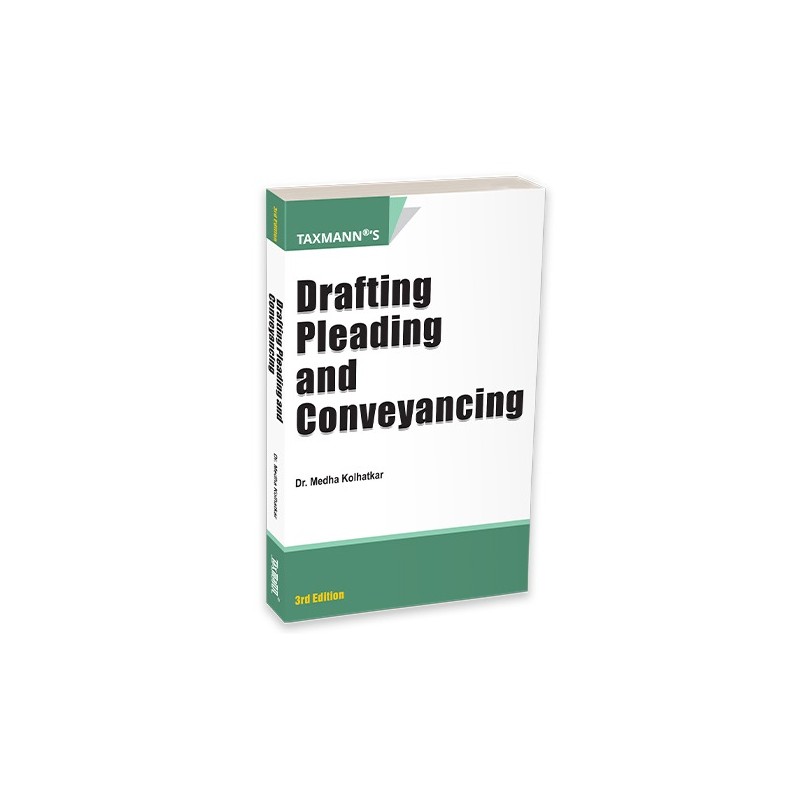
Drafting Pleading and Conveyancing By Medha Kolhatkar
Drafting Pleading and Conveyancing by Dr Medha Kolhatkar is a practical guide to legal drafting. It explains the rules behind the documents a lawyer drafts and shows them at work in specimen drafts. In one volume, it covers notices, pleadings and applications before courts and tribunals, affidavits, arbitration documents, and conveyancing deeds and wills.
The success of a case depends largely on its drafting. Pleadings that leave out a material fact can cost a litigant the entire cause of action, and an inaccurately drafted sale deed can cloud a title for generations. This book is built to bridge the gap between theory and practice. Most topics explain what the draftsman must know and then show a finished draft.
The 17 chapters move from principles to practice. They start with the principles of drafting, notices and pleadings. They go on to civil, family, succession, writ, consumer and motor accident matters and affidavits, and end with arbitration, criminal law and conveyancing.
This book is intended for the following audience:
- LL.B. Students studying drafting, pleading and conveyancing
- Teachers of Drafting, who need ready specimens and drafting points for the classroom
- Interns and Young Advocates learning to draft notices, plaints, written statements and applications
- Practising Advocates in civil, family, consumer, motor accident, criminal and arbitration matters
- Property and Conveyancing Lawyers who draft deeds and wills and prepare title search reports
- Law Firms and In-house Legal Teams that draft notices, agreements, arbitration clauses and powers of attorney
The Present Publication is the 3rd Edition and has been revised and updated to reflect recent rulings, changes in the law, and new specimens. The chapter on drafting and pleading under criminal law has been thoroughly revised to align with the new criminal laws of 2023, and a new chapter on drafting under arbitration law has been added. It is authored by Dr Medha Kolhatkar (B.S.L., LL.M., PhD), a research scholar and faculty member at the Indian Law Society’s Law College (ILS Law College), Pune, with the following noteworthy features:
- [More than 180 Specimens] The book gives more than 180 specimen drafts for the documents lawyers handle every day: legal notices and replies, plaints, written statements, civil applications, appeals, review and revision applications, matrimonial and succession petitions, writ petitions, consumer complaints, motor accident claims, affidavits, criminal complaints and bail applications, arbitration documents, and deeds and wills
- [Para-by-Para Drafting Guidance] Drafting points list what a document must contain. For a marriage petition, the book sets out what each paragraph should state, from the details of the marriage to the no-collusion declaration, jurisdiction, court fee and prayer. The consumer law chapter gives an annotated model complaint. The motor accident claim petitions are set out item by item, with notes on what to enter
- [Ready to Adapt] Specimens leave blanks for names, dates, places and amounts. Many also carry bracketed prompts, such as ‘(give the description of goods)’. Court documents use the cause title of the right forum: Civil Judge, Small Causes Court, District Court, High Court, Family Court, Consumer Commission, Motor Accident Claims Tribunal, Judicial Magistrate, Sessions Court or Arbitral Tribunal. The plaints set out the cause of action, jurisdiction, court fee and reliefs claimed, and most also deal with limitation and valuation. Each plaint carries a verification and a note that a supporting affidavit is filed
- [Both Sides of a Dispute] More than a dozen drafts are written for the opposite party: replies to notices, written statements, a reply to an injunction application, and replies to matrimonial petitions. Chapter 6 also lists the defences a defendant can raise in 11 kinds of suits
- [New Criminal Laws] The criminal law chapter is updated for the Bharatiya Nyaya Sanhita (BNS), the Bharatiya Nagarik Suraksha Sanhita (BNSS) and the Bharatiya Sakshya Adhiniyam (BSA) 2023. It opens with the key features of the BNSS and the BNS, and the main terms of the BNSS. Its 25 specimens include:
- Complaints for criminal trespass, bigamy, defamation, cheating, cheque dishonour and cruelty
- Bail and anticipatory bail applications
- Petitions and applications for maintenance under the BNSS
- Criminal appeals and revisions
- [Arbitration, Start to Finish] Ten specimens under the Arbitration and Conciliation Act 1996 take a dispute from the agreement to the challenge to the award:
- Arbitration agreements and clauses, including one for a partnership firm
- A notice invoking arbitration under section 21
- Applications to appoint an arbitrator (section 11), for interim measures from the court (section 9) or the arbitral tribunal (section 17), and to set aside the award (section 34)
- Explanatory notes cover each provision, including limitation and appeals where relevant. For most of these documents, they also list what the document must contain
- [Conveyancing, from Title to Deed] The conveyancing chapter explains each part of a deed, from the title, parties and recitals to the habendum, testimonium, schedule, execution and attestation. It also gives the rules on stamping and registration. A section on investigation of title and e-search lists the 12 matters a title search report should cover. The chapter then takes up 14 instruments, from acknowledgements, adoption and gift to lease, mortgage, partnership, power of attorney, sale, trust and wills. For each, it notes the stamp duty and registration needed and gives at least one specimen
- [Case Law up to 2026] Over 300 cases are cited, including nearly 40 rulings reported in 2025 and 2026. Among them are Supreme Court rulings on wills, gifts, adoption, partition, arbitral awards, maintenance and motor accident claims
The coverage of the book is as follows:
- Chapter 1 | Principles of Legal Drafting
- Why drafting matters, the principles of good drafting (with Fowler’s and Charles Davidson’s rules), and the pros and cons of technology in drafting
- Chapter 2 | Notices
- Statutory, mandatory, directory, public, private, actual and constructive notices, modes of service, and how to draft notices and replies, with specimens of legal notices, replies and a public notice
- Chapter 3 | Pleadings
- Objectives and fundamental rules of pleading, construction and striking out of pleadings, alternative and inconsistent pleadings, signature and verification, and amendment
- Chapter 4 | Plaint
- Particulars of a plaint, from the title and parties to cause of action, jurisdiction, relief, valuation and limitation, plus return and rejection of a plaint, verification and annexures
- Chapter 5 | Drafting of Civil Suits
- Suits under the law of torts (defamation, nuisance, trespass, malicious prosecution, negligence)
- Suits on contract, partnership and promissory notes (recovery of price of goods sold and delivered, dissolution of partnership and accounts, suits on promissory notes)
- Suits relating to immovable property (specific performance, cancellation of instruments, partition, eviction and possession)
- Chapter 6 | Written Statement
- Time for filing, documents to be filed, denials, dilatory pleas, objections in point of law and special defences, set-off and counter-claim, and the defences available in different suits
- Chapter 7 | Civil Applications and Execution Petition
- Applications for adjournment, substituted service, court commissioner and receiver, arrest and attachment before judgment, temporary injunction, legal heirs, indigent persons, restoration, stay, mesne profits, amendment and caveat, and the execution petition
- Chapter 8 | Appeal, Review and Revision
- First and second appeals, cross-objections, appeals from orders and to the Supreme Court, review and revision, with the limitation for appeal, review and revision
- Chapter 9 | Drafting of Petitions under Matrimonial Laws
- Essentials of a marriage petition
- Petitions for restitution of conjugal rights, judicial separation, nullity and divorce (mutual consent, cruelty, desertion, adultery), with replies
- Maintenance pendente lite and permanent alimony
- Chapter 10 | Drafting of Petitions under Law of Succession
- Succession certificates and probate, including probate of a lost will
- Chapter 11 | Writ Petitions
- Habeas corpus, mandamus, prohibition, quo warranto and certiorari, with a specimen petition for each
- Chapter 12 | Drafting of Complaints and Applications under Consumer Law
- Salient features of the Consumer Protection Act 2019, who can file and where, contents of a complaint and reply, complaints for deficiency in service and defective goods, condonation of delay and appeals
- Chapter 13 | Petitions and Applications under Motor Vehicles Act 1988
- Compensation for hit-and-run accidents, no-fault liability, and claims under section 166 for death and bodily injury
- Chapter 14 | Affidavits
- Affidavits under the CPC and the BNSS, the effect of a false affidavit, and how to draft one, with affidavits for bail applications, writ petitions, interim and delay-condonation applications, plaints, and a lost sale deed
- Chapter 15 | Drafting under Arbitration Law
- Arbitration agreements and clauses, the notice invoking arbitration, and applications to appoint an arbitrator, for interim measures and to set aside an award
- Chapter 16 | Drafting and Pleading under Criminal Law
- Key terms under the BNSS, criminal complaints, bail and anticipatory bail, maintenance, other applications, criminal appeals and revision
- Chapter 17 | Conveyancing—Practice and Procedure
- Components, interpretation, stamping and registration of deeds, and investigation of title and e-search
- Acknowledgements, adoption, gift, indemnity, lease, leave and licence, mortgage, partition, partnership, power of attorney, release, sale, trust, and wills and codicils
Each chapter is built on a common plan:
- Opening — A quotation, often from the Supreme Court, followed by a synopsis that lists the chapter’s sections
- Numbered Paragraphs — The text runs in numbered paragraphs, such as 5.1.3 or 17.1.4.7, each with its own heading
- Law, then Drafting Points — Each topic first explains the law behind the document. Drafting points follow where the topic needs them
- Specimens — Where a topic has specimens, they come at the end. Where there is more than one, they are numbered in Roman numerals (Specimen No. I, II and so on), and most carry a heading that names the document. Most pleadings, petitions and applications run from the cause title and parties, through numbered paragraphs, to the prayer and signatures. Deeds such as gift, lease, mortgage, partition and sale deeds run from the parties and recitals to the operative clauses, the schedule of property, the testimonium and attestation
- Footnotes — Cases and other authorities are cited in footnotes on the same page