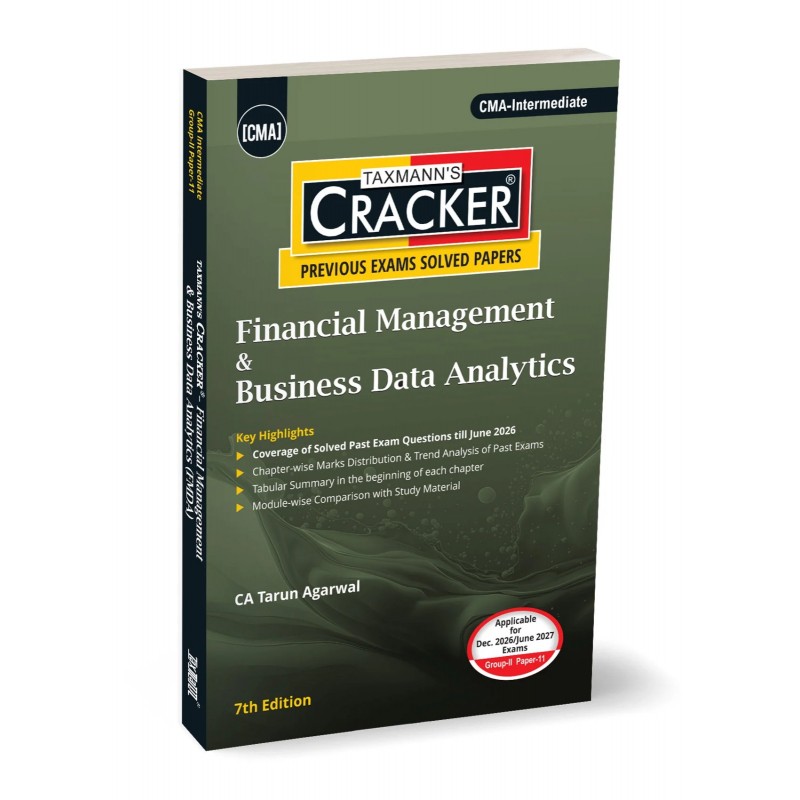
Financial Management & Business Data Analytics – CRACKER is a dedicated, exam-oriented title, written for Paper 11 of CMA Intermediate (Group II) under the ICMAI 2022 Syllabus. It is not a conventional textbook; it is a focused revision-and-practice companion that converts the entire syllabus into a solved question-bank, arranged so that a student practises exactly the way marks are awarded in the examination.
The heart of the book is its large bank of past examination questions answered in full, examiner-style detail, sequenced topic-wise within each chapter. Every chapter opens with the cover-billed Tabular Summary—printed inside as ‘A Quick Review’—a compact refresher of the important definitions, concepts and formulae, after which the past-exam questions follow, each stamped with the sitting it appeared in and the marks it carried. Around this core, the book adds a layer of exam intelligence: chapter-wise (module-wise) marks distribution, a question-by-question trend analysis of recent sittings, and a mapping of every chapter to the ICMAI Study Material. In this Edition (July 2026), the content has been refreshed and extended to include solved questions up to the June 2026 exam, keeping it fully current for the upcoming attempts.
The Present Publication is the 7th Edition | July 2026, authored by CA. Tarun Agarwal, with the following noteworthy features:
- [Solved Past-Exam Questions up to June 2026] An extensive, chapter-wise question bank with complete, step-by-step answers. Questions span multiple past sittings, so students see how topics have actually been examined over the years
- [Every Question is Exam-Tagged] Each carries its source sitting and mark value (e.g., [Dec. 2017, Dec. 2019, 1 Mark]). Where a question has been repeated across sittings, all appearances are shown—an instant signal of the most frequently tested points
- [Tabular Summary (‘A Quick Review’)] A crisp, at-a-glance recap of important definitions, key concepts and formulae for rapid pre-exam recall before attempting the questions
- [Chapter-wise Marks Distribution & Trend Analysis] A module-wise marks table (2023–2026) plus a detailed, question-by-question trend analysis, so revision time can be steered toward the highest-yield areas
- [Module-wise Comparison with ICMAI Study Material] Every chapter is mapped to the Institute’s official Study Material module, giving students confidence that the whole syllabus is covered and nothing is missed
- [Full Mix of Question Types] Objective/MCQ, short and descriptive theory, and practical numerical problems—each solved—so both the conceptual and the computational sides of the paper are covered
- [Theory vs. Practical Tagging] Questions are categorised so students immediately know whether an item tests understanding or problem-solving
The book covers the complete Paper 11 syllabus across 11 chapters, grouped into the paper’s two sections. Under the ICMAI 2022 Syllabus the paper carries 100 marks, with Section A (Financial Management) as the larger component and Section B (Business Data Analytics) completing the paper.
- Section A — Financial Management
- Fundamentals of Financial Management — Objectives (profit vs. wealth maximisation), scope, the investment/financing/dividend decisions, risk–return, and time value of money concepts
- Institutions and Instruments in Financial Markets — Money and capital markets, financial instruments, and market participants
- Tools for Financial Analysis — Comparative and common-size statements, ratio analysis, and fund-flow/cash-flow analysis. (Consistently the single highest-scoring chapter in the trend data)
- Sources of Finance and Cost of Capital — Short- and long-term financing sources and computation of cost of capital (debt, equity, preference, WACC)
- Capital Budgeting — Investment appraisal techniques (payback, ARR, NPV, IRR, PI) with their merits and limitations
- Working Capital Management — Working-capital estimation, and management of cash, receivables and inventory
- Financing Decisions of a Firm — Leverage (operating, financial, combined) and capital-structure decisions
- Section B — Business Data Analytics
- Introduction to Data Science for Business Decision-Making — Nature and kinds of data, and the role of data in finance and costing
- Data Processing, Organisation, Cleaning and Validation — Preparing and validating data for analysis
- Data Presentation | Visualisation and Graphical Presentation — Presenting data through charts, graphs and visual formats
- Data Analysis and Modelling — The data-analytics process and the descriptive/diagnostic/predictive/prescriptive analytics types
- The trend analysis makes the weighting transparent: within Financial Management, Tools for Financial Analysis (~25 marks average), Working Capital Management (~17.6 marks), Capital Budgeting (~16.7 marks) and Financing Decisions of a Firm (~16.7 marks) are the heaviest, recurring scorers; within Business Data Analytics, Data Analysis and Modelling and Introduction to Data Science carry the most marks. Students can use this to prioritise effort with precision
The book follows a clear plan → review → practise flow.
- Analytical Tools (Build Your Strategy First) — Before the chapters begin, three planning tools set up a data-driven study plan:
- Module-wise Marks Distribution (2023–2026) — Marks per module across June and December sittings, with a four-year average
- Previous Exams Trend Analysis — A question-by-question breakdown of recent papers, each item tagged by chapter, marks, compulsory status, and Theory vs. Practical category
- Module-wise Comparison with Study Material — A table aligning all 11 chapters to the ICMAI Study Material’s Modules 1–11 across both sections
- Inside Each Chapter (Review, Then Drill) — Every chapter opens with ‘A Quick Review’ (grouping the important definitions, key concepts, and formulae) for fast recall, and then presents past exam questions with full solutions, arranged topic-wise. MCQs are answered with the correct option; theory questions receive structured written answers; and numerical problems are solved with complete workings so the method—not just the final figure—is clear
- Two-section Alignment with the Exam — The chapter sequence mirrors the paper’s split between Financial Management (Section A, Chapters 1–7) and Business Data Analytics (Section B, Chapters 8–11), so practice maps directly onto how the paper is set and marked.