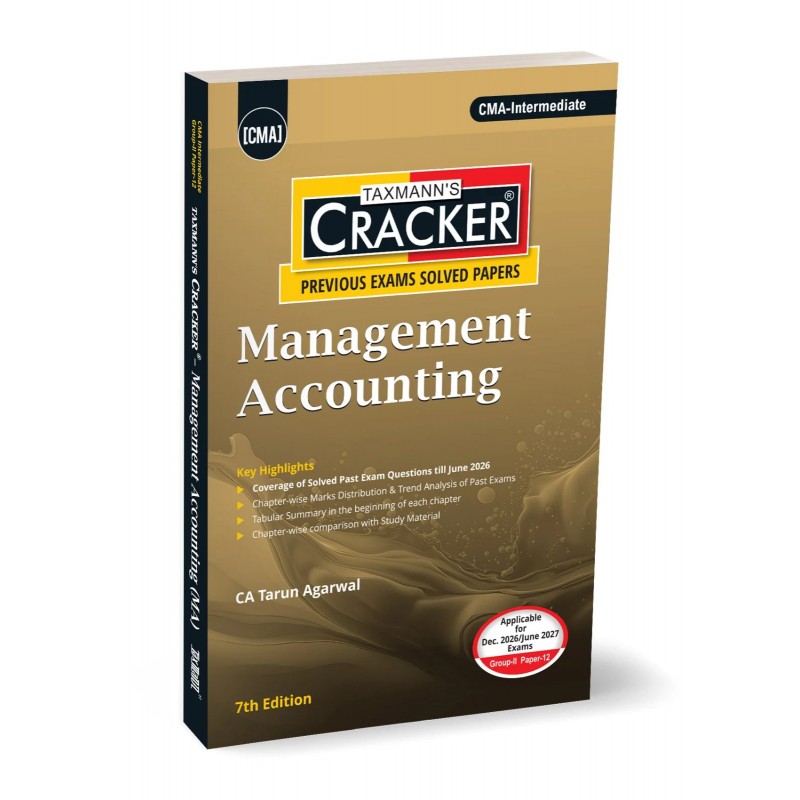
Management Accounting – CRACKER is a purpose-built, exam-oriented question bank from Taxmann’s acclaimed CRACKER series, prepared specifically for CMA Intermediate (Group II – Paper 12) under the 2022 Syllabus of the Institute of Cost Accountants of India (ICMAI).
The CRACKER is not a conventional textbook—it is a scoring tool. Across more than 400 pages, it condenses the entire Paper 12 syllabus into ten tightly organised chapters, each opening with a concise theory digest (‘A Quick Review’) and then moving straight into an extensive bank of past examination questions solved in full, with step-by-step workings. The design philosophy is simple: refresh a concept, then immediately practise it exactly as ICMAI has asked in the exam hall.
What sets this book apart is the depth of its archive of solved questions. It doesn’t merely reproduce the last few papers—it compiles questions spanning more than a decade of past exams—from 2013 through the June 2026 attempt, covering both objective/MCQ-type and full descriptive/practical problems. The book is fully refreshed for the December 2026 and June 2027 examination cycles, with the latest attempts incorporated and the syllabus mapping kept up to date.
The Present Publication is the 7th Edition | July 2026, authored by CA. Tarun Agarwal, with the following noteworthy features:
- [Solved Past-Exam Questions up to June 2026] An up-to-date bank of previous questions, each worked out completely (final answer, detailed Working Notes & tabular computations), so students absorb both the answer and the examiner-approved method
- [A Deep, Decade-spanning Archive] Questions are drawn from many attempts (roughly 2013 through June 2026), giving far more practice material than a ‘last-few-papers’ compilation
- [Chapter-wise Marks Distribution] An at-a-glance grid showing marks carried by each chapter across recent attempts, with a 7-attempt average, so students can rank topics by importance before they study
- [Previous Exams Trend Analysis] A granular, question-by-question map of past papers listing the question number, whether it was compulsory, the chapter, the marks, and whether it was Theory, Practical, or both—a genuine blueprint of the paper’s pattern
- [Tabular ‘A Quick Review’ Opening Every Chapter] A summarised theory snapshot (important definitions, key concepts, features, limitations and comparison tables) for rapid pre-exam recall
- [Chapter-wise Comparison with the ICMAI (CMA) Study Material] A mapping table aligning each chapter to the corresponding CMA Study Material Module (1–10), so nothing in the syllabus is left uncovered and cross-referencing is effortless
- [Objective & Descriptive Coverage] Every chapter begins with Objective Questions (MCQs, fill-in-the-blanks and one-liners, each tagged with attempt and marks) before progressing to full theoretical and numerical problems
- [Authoritative, Terminology-grounded Theory] The ‘Quick Review’ recaps lean on CIMA Official Terminology for definitions, keeping conceptual answers precise and exam-ready
- [Concise, Revision-first Presentation] Content is trimmed to what actually scores, making the book ideal for study under time pressure.
The book covers the complete Paper 12 syllabus across ten chapters, each mapped one-to-one to the corresponding module of the ICMAI (CMA) study material. Chapter by chapter, the coverage is:
- Chapter 1 – Introduction to Management Accounting
- Meaning, scope and evolution of management accounting
- Role, functions and responsibilities of the management accountant
- Management accounting vs. financial accounting vs. cost accounting
- Impact of the new business environment (global competition, IT, ESG/sustainability, value creation)
- Chapter 2 – Activity Based Costing (ABC)
- Cost pools, cost drivers and activity-based cost allocation
- ABC compared with traditional (absorption) costing
- Application of ABC to product and service costing
- Chapter 3 – Marginal Costing
- Marginal vs. absorption costing and the difference in income statements
- Cost-Volume-Profit (CVP) analysis and break-even analysis
- Contribution, P/V ratio, margin of safety and profit planning
- Chapter 4 – Applications of Marginal Costing in Short-Term Decision Making
- Make-or-buy decisions
- Key-factor/limiting-factor and optimum product-mix decisions
- Pricing, special-order and accept/reject decisions
- Shut-down vs. continue and other short-term choices
- Chapter 5 – Transfer Pricing
- Purpose of transfer pricing and inter-divisional transfers
- Cost-based, market-based and negotiated transfer-pricing methods
- Goal congruence and divisional-autonomy considerations
- Chapter 6 – Standard Costing & Variance Analysis
- Setting standards and the mechanics of variance analysis
- Material, labour and overhead variances
- Sales variances and reconciliation of budgeted vs. actual profit
- Chapter 7 – Forecasting, Budgeting & Budgetary Control
- Forecasting techniques and the budgeting framework
- Types of budgets, functional/cash budgets and flexible budgeting
- Budgetary control and variance reporting
- Chapter 8 – Divisional Performance Measurement
- Evaluating the performance of divisions and segments
- Return on Investment (ROI) and Residual Income (RI)
- Measuring and comparing divisional performance
- Chapter 9 – Responsibility Accounting
- Responsibility centres—cost, revenue, profit and investment centres
- Controllable vs. uncontrollable costs
- Performance reporting under responsibility accounting
- Chapter 10 – Decision Theory
- Decision-making under risk and uncertainty
- Decision criteria—maximin, maximax, minimax regret and expected value
- Expected Value of Perfect Information (EVPI) and decision trees
The book follows a consistent, easy-to-navigate architecture built for efficient revision.
- Revision Navigation Tools
- Chapter-wise Marks Distribution (with averages)
- Previous Exams Trend Analysis (attempt-by-attempt, question-by-question)
- Chapter-wise Comparison with Study Material (mapping each chapter to its CMA Study Material Module)
- Within Each Chapter
- A Quick Review — A structured theory digest, typically flowing from Important Definitions (grounded in CIMA Official Terminology) → Other Important Concepts → Features and Limitations → Comparison tables (for example, ‘Absorption Costing v. Marginal Costing’ or ‘Financial vs Cost vs Management Accounting’). This gives students the conceptual foundation and the exact phrasing needed for theory marks
- Past Examination Questions — A graded practice set that starts with Objective Questions (each tagged with its exam and mark value, followed by the answer and a short working) and then builds up to full descriptive and practical/numerical problems, every one solved with complete Working Notes and tabulated calculations
- This ‘concept snapshot → solved practice‘ design repeats chapter after chapter, letting a student revise a topic and immediately test it against genuine exam questions