CMA Inter Financial Accounting Cracker Tarun Agarwal Dec 26 Exam
CMA Inter Financial Accounting Cracker Tarun Agarwal Dec 26 Exam
Description
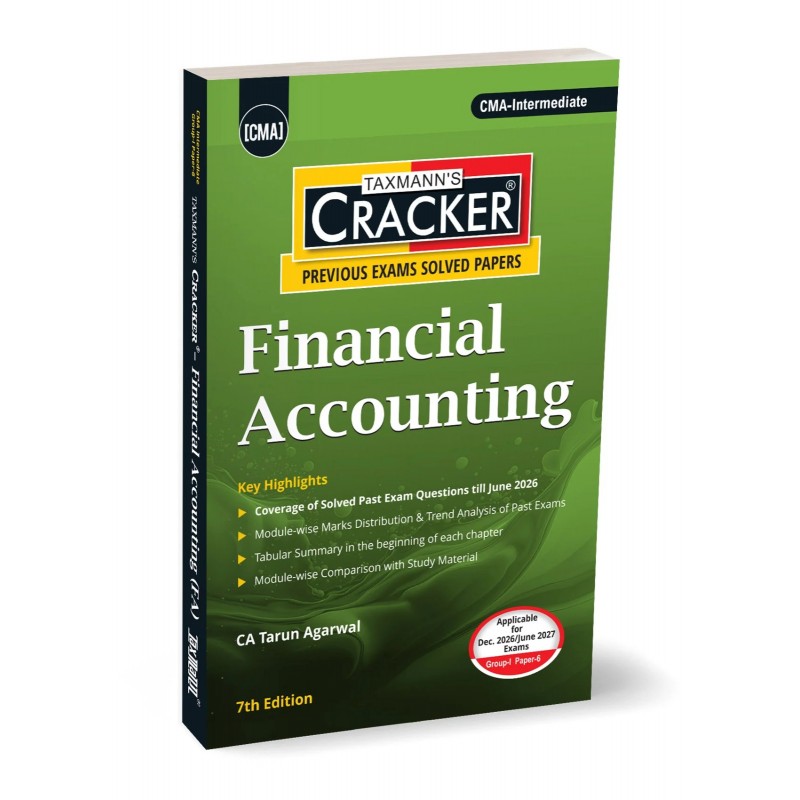
Financial Accounting – CRACKER for Paper 6 of the CMA Intermediate (Group I) examination is a dedicated, exam-first companion built around practising real, previously asked questions rather than re-reading theory. Across roughly 500+ pages, it assembles the paper’s past examination questions—arranged module-by-module over the entire syllabus—and pairs each with a complete, worked solution, so a candidate can revise a concept and immediately see how the examiner has actually tested it.
What sets the CRACKER apart is its analytical, data-led approach to revision. Before the questions begin, the book quantifies the paper: it shows how marks have historically been allocated across modules, breaks down every recent paper question by question, and maps its own contents against the official ICMAI study material. Each question then carries its exam session(s) and marks, and questions that have appeared in more than one sitting are explicitly flagged (for example, ‘Similar Question in June 2026, 7 Marks’)—a direct signal of what is repeatedly examined.
The book is fully updated and applicable for the December 2026 and June 2027 examinations under Syllabus 2022, with solved questions incorporated up to and including the June 2026 attempt. Its question bank draws on more than a decade of past papers (2011 through June 2026), giving unusually deep coverage of how each topic has evolved.
The Present Publication is the 7th Edition | July 2026, authored by CA. Tarun Agarwal, with the following noteworthy features:
- [Fully Solved Past Exam Questions till June 2026] Every relevant previously asked question, each with a detailed, step-by-step model answer
- [Deep Historical Question Bank] Questions drawn from 2011 through June 2026, so students see how each topic has been framed across many sittings, not just the latest few
- [Module-wise Marks Distribution] A consolidated table showing marks spread across modules and chapters over the last seven sittings (June & December, 2023–2026), with a per-topic average to guide prioritisation
- [Previous Exams Trend Analysis] A question-by-question breakdown of each recent paper (July 2023 → June 2026), mapping every question to its chapter, marks, and nature (Theory/Practical)
- [Exam-tagged Questions] Each question shows its source session(s) and marks (e.g., [Dec. 2017, Dec. 2018, 1 Mark]), and repeat/’similar’ questions across sittings are flagged so high-yield items stand out
- [A ‘Quick Review’ (Tabular Summary)] Key definitions, concepts, and formulae presented up front for fast last-minute revision
- [Module-wise Comparison with the ICMAI Study Material] A one-to-one mapping of the book’s nine modules to the corresponding CMA Study Material module numbers, so nothing prescribed is missed
- [Detailed Working Notes] Numerical solutions are supported by full working notes (120+ across the book), modelling proper exam presentation
- [Balanced Objective & Practical Coverage] Mirrors the paper’s real structure, combining objective questions with full-length numerical problems
The book covers the complete Paper 6 syllabus, organised into nine modules that align 1:1 with the ICMAI study material:
- Accounting Fundamentals
- Concepts, conventions, GAAP, the accounting cycle, capital vs revenue, and Adjustments & Rectification of Errors
- Accounting for Special Transactions
- Bills of Exchange, Consignment, and Joint Venture
- Preparation of Financial Statements
- Of Commercial Organisations, of Not-for-Profit Organisations, and from Incomplete Records/single entry
- Partnership Accounting
- Consistently the single highest-weighted area of the paper
- Lease Accounting
- Branch and Departmental Accounts
- Insurance Claim for Loss of Stock and Loss of Profit
- Hire Purchase and Instalment Sale Transactions
- Accounting Standards
The book is designed so a student can diagnose → revise → practise in one place:
- Strategy-setting — It opens with three planning tools—the Module-wise Marks Distribution, the Previous Exams Trend Analysis (question-by-question), and the Module-wise Comparison with the ICMAI Study Material—giving a clear picture of where marks come from before any solving begins
- A Consistent Per-chapter Flow — Each chapter follows the same rhythm:
- A Quick Review — The essential concepts, definitions, and formulae, summarised up front
- Objective Questions — MCQs (with answer keys), plus True/False (‘state whether’), match-the-following, and fill-in-the-blank items for concept testing
- Numerical Problems — Full-length practical questions with complete, worked solutions and working notes
- Exam-labelled, Prioritizable Questions — Every question carries its originating attempt(s) and marks and is identifiable as theory or practical, letting students work by weightage and question type.
About the Author
CA Tarun Ramgopal Agarwal is a distinguished All-India Rank Holder at all levels of the Chartered Accountancy exams, earning a Gold Medal in Financial Reporting in the CA Final. In 2010, he was honoured by the Chartered Accountants Association, Ahmedabad, as the best CA student in Gujarat for securing 1st Place in the CA Final in the state. He holds multiple qualifications, including B.Com., CS, LL.B., CFA (Level 2), and FRM.