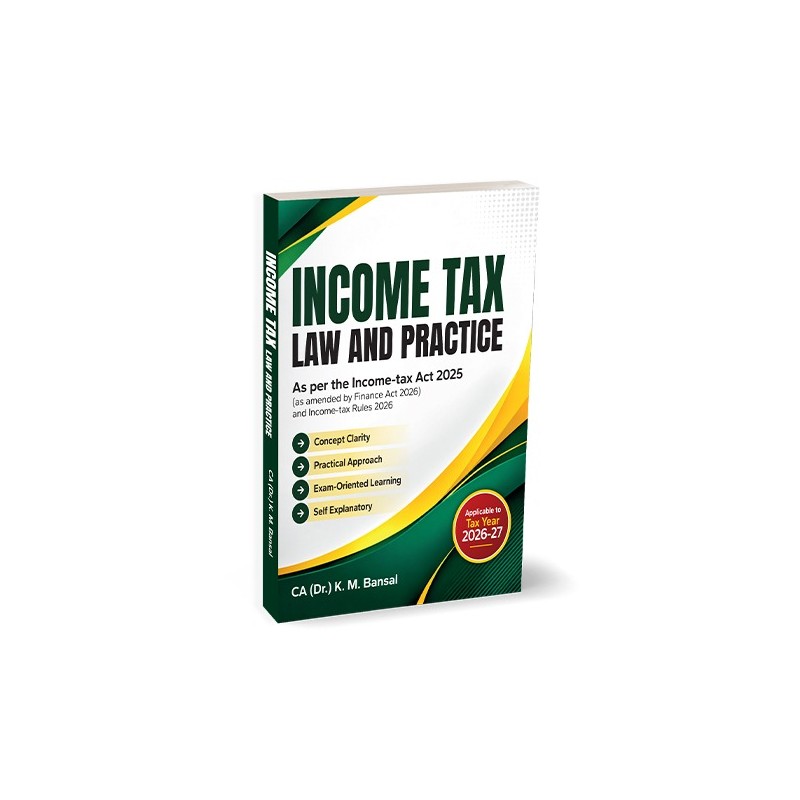
Income Tax Law and Practice By K.M. Bansal
Income Tax | Law and Practice by CA. (Dr) K.M. Bansal is a textbook on income-tax for students of Commerce and Management. It is based on the Income-tax Act 2025, as amended by the Finance Act 2026, and the Income-tax Rules 2026. It applies to Tax Year 2026-27.
Income-tax is hard for many students. The language is technical, the law is amended often, and much of the subject is computation. This book is built to make it easier. It explains each provision in plain words, shows it at work through examples, and then gives the student problems to solve. Topics start from the basic principle and build up step by step to typical and then comprehensive problems.
The 22 chapters follow a logical order. They begin with basic concepts and residential status, then cover exempt income and the heads of income, and build up to the computation of total income and tax. The later chapters deal with HUFs, firms and LLPs, and with compliance: returns, advance tax, interest, and tax deduction and collection at source.
This book is intended for the following audience:
- Undergraduate and Postgraduate Students of Commerce And Management, at the University of Delhi and at other universities and institutions across India
- Teachers of Income-tax, who need ready examples, solved illustrations and question sets for the classroom
- Students who study on their own and want full solutions to check their work
- Teachers and Students who know the Income-tax Act 1961 and are moving to the new Act and its section numbers
The present publication is the November 2026 edition, applicable to Tax Year 2026-27. It is based on the Income-tax Act 2025, as amended by the Finance Act 2026, and the Income-tax Rules 2026. It takes into account amendments, notifications and rules available at the time of finalisation. It is authored by CA (Dr.) K.M. Bansal, Professor, Department of Commerce, Dr B.R. Ambedkar College, University of Delhi, and includes the following noteworthy features:
- [Concept Clarity] Topics start from the basic principle and build up step by step, in plain language. Nearly 500 examples sit right after the points they explain. Notes flag the exceptions, and comparison and at-a-glance tables pull the main points together. Diagrams map out residential status and the clubbing provisions
- [Practical Approach] The book shows how each computation is done, not just what the rule says. Formats set out the working for salary, house property, business and capital gains income, and for gross total income, total income and tax. The business-income illustrations start from the accounts of a trader, manufacturer or professional and work through to taxable income. Chapter 16 brings the heads together in nine comprehensive illustrations
- [Exam-oriented Learning] Every chapter has a ‘Test Your Knowledge’ section. Together they hold over 200 questions: theory questions, ‘distinguish between’ questions, short notes and practical problems. Many problems carry a tag naming the topic they test. Answers are given for most of the practical problems
- [Self-explanatory] Nearly 100 chapter-end illustrations are solved in full. Each solution sets out the working step by step, mostly in tables, and many add working notes that explain how a figure is reached. Numerical examples also give their answers. Cross-references point back to the paragraph where a rule is explained. The book works for self-study as well as in the classroom
- [Both Tax Regimes, Side by Side] The default and optional tax regimes are covered throughout. Where the choice of regime changes the result, the book shows both, often in side-by-side columns. Several illustrations work out the tax under each regime and advise which is better
- [Old and New Section Numbers] A Comparative Reference Table at the front covers over 300 important provisions. For each one, it gives the section under the Income-tax Act 1961 and the matching section under the Income-tax Act 2025. It is grouped by topic, from definitions and residential status to TDS, advance tax and refunds
- [Built on the Income-tax Act 2025] The book uses the terms, section numbers and computation framework of the new Act throughout. So it speaks of the ‘tax year’, not the ‘previous year’ and ‘assessment year’. Chapter 1 explains why the 1961 Act was replaced, what changed in the structure of the law, and which Act applies to which year. It also shows students how to read a statutory reference.
- [Updated for Tax Year 2026-27] Examples, illustrations and questions are set in Tax Year 2026-27. Where the Finance Act 2026 has changed a rule, the text points it out, often in a separate note. Rule references are to the Income-tax Rules 2026
The coverage of the book is as follows:
- Comparative Reference Table of Important Provisions
- Income-tax Act 1961 and Income-tax Act 2025
- Chapter 1 | Introduction
- Meaning and types of taxes, the constitutional basis of income-tax, how income-tax law developed in India, why a new Act was needed, its main structural changes, and the move from the 1961 Act to the 2025 Act
- Chapter 2 | Basic Concepts
- Tax year, charge of income-tax, person, assessee and income, unexplained income, heads of income, gross total income and total income, tax regimes, rates, rebate, surcharge and cess, PAN, and the basic computation of tax
- Chapter 3 | Residential Status and Scope of Total Income
- Residential status of individuals, HUFs, firms, companies and other persons, the scope of total income, and income received or deemed to accrue or arise in India
- Chapter 4 | Incomes which do not Form Part of Total Income
- The main exemptions, from agricultural income and life-insurance receipts to the income of political parties, with an appendix on Schedules II to VIII
- Chapter 5 | Income under the Head ‘Salaries’
- Allowances, perquisites and their valuation, ESOPs and sweat equity, retirement funds, profits in lieu of salary, deductions from salary, and retirement benefits such as gratuity, pension and leave encashment
- Chapter 6 | Income under the Head ‘Income from House Property’
- Annual value of let-out, vacant and self-occupied property, deductions, interest on borrowed capital, loss from house property, arrears and unrealised rent, and co-owned property
- Chapter 7 | Profits and Gains from Business or Profession
- Chargeable income, allowable deductions, depreciation, disallowances, deductions on actual payment, presumptive taxation, books of account and tax audit
- Chapter 8 | Capital Gains
- Capital assets and transfer, computation of short-term and long-term gains, cost of acquisition, special cases, exemptions, and the rates on capital gains
- Chapter 9 | Taxation of Gifts
- Money and property received without consideration or for inadequate consideration, the exceptions, and valuation of property
- Chapter 10 | Income from Other Sources
- Dividends, winnings, employees’ contributions, keyman insurance, interest on securities, letting of plant and machinery, compensation and insurance receipts, and the deductions allowed and refused
- Chapter 11 | Clubbing of Income (Income of Other Persons Included in an Assessee’s Total Income)
- Transfers of income or assets, income of a spouse, son’s wife and minor child, cross transfers, and recovery of tax on clubbed income
- Chapter 12 | Set-Off and Carry Forward of Losses
- Set-off within a head and across heads, carry forward of each type of loss, and the order of set-off
- Chapter 13 | Deductions from Gross Total Income
- Deductions for investments, pension contributions, health insurance, medical treatment, loan interest, donations, rent, royalties and deposit interest, with profit-linked and disability deductions
- Chapter 14 | Tax Rates, Rebates and Reliefs
- The two regimes, normal and special rates, cess, rebate, surcharge and marginal relief, relief for salary arrears, foreign retirement-benefit accounts, and relief from double taxation
- Chapter 15 | Agricultural Income
- What counts as agricultural income, apportionment of composite income, computation of net agricultural income, and partial integration
- Chapter 16 | Computation of Total Income and Tax Liability of Individuals
- A step-by-step sequence for the full computation, applied in nine comprehensive illustrations
- Chapter 17 | Assessment of Hindu Undivided Families
- When income belongs to the HUF, its residential status, gifts and converted property, computation of its income and tax, and partition
- Chapter 18 | Assessment of Firms Including LLPs
- How a firm and an LLP compare, conditions for assessment as a firm, interest and remuneration to partners, the firm’s tax, the partners’ tax, and changes in constitution, succession and dissolution
- Chapter 19 | Return of Income
- Who must file, due dates and forms for Tax Year 2026-27, types of return, verification, PAN, and the consequences of delay
- Chapter 20 | Advance Payment of Tax
- Who must pay, computation, instalments and due dates, revised estimates, and the consequences of default
- Chapter 21 | Interest Payable by Assessee or Government
- Interest for late return, advance-tax default and deferment, excess refund, late payment of demand and TDS or TCS default, and interest on refunds
- Chapter 22 | Tax Deduction and Collection at Source
- TDS on salary and on payments to residents and non-residents, no or lower deduction, TCS, PAN and TAN, statements and certificates, and the consequences of failure
Each chapter is built on a common plan:
- Learning Objectives — The chapter opens with a box listing what the reader should be able to do after studying it. Many chapters add a short note on what the chapter covers
- Provisions at a Glance — In most chapters, a table then lists the sections, and often the Rules, that govern the topic
- Numbered Paragraphs — The text runs in numbered paragraphs, such as 5.22. Most headings name the section, Schedule or Rule they deal with
- Examples, Formats and Notes — Examples follow the point they illustrate. Computation formats, notes and summary tables appear where a topic needs them
- Chapter-end Illustrations — In most chapters, solved illustrations at the end apply several provisions together
- Test Your Knowledge — The chapter’s text closes with a set of questions